

SEND datasets are the standardized, machine-readable files the U.S. FDA requires for nonclinical study data in most drug and biologics submissions. If you run toxicology studies, assemble regulatory filings, or manage data at a CRO, SEND datasets are no longer optional for in-scope studies. This guide explains what SEND is, who needs it, which studies require it, how the SENDIG versions differ, and how to submit data that clears FDA validation on the first pass. It also covers where global regulators like PMDA and EMA currently stand, so you can plan submissions across markets without guesswork.
Read it start to finish for a full grounding, or jump to the section that answers your immediate question.
What Are SEND Datasets?
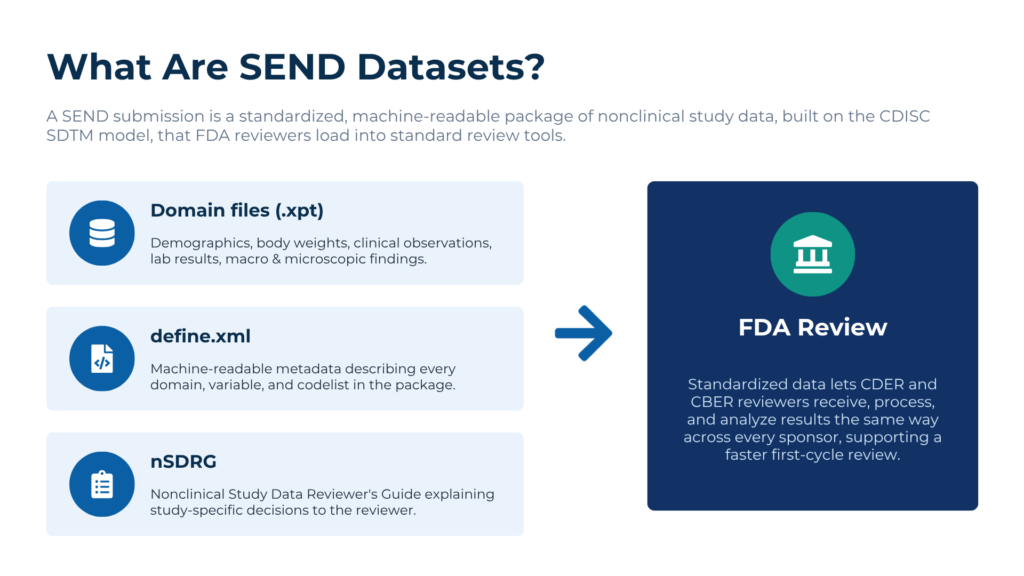
SEND (Standard for Exchange of Nonclinical Data) is a CDISC standard that organizes animal study data into a consistent, machine-readable structure for regulatory review. SEND datasets are the individual domain files that make up that structure: demographics, body weights, clinical observations, laboratory results, macroscopic and microscopic findings, and more.
Each domain is submitted as a SAS transport file (.xpt), accompanied by a define.xml file that describes the metadata, and a nonclinical Study Data Reviewer’s Guide (nSDRG) that explains study-specific decisions to the reviewer. Together these files let an FDA toxicologist load your data into standard review tools instead of re-keying numbers out of a PDF report.
The point of SEND is speed and consistency of review. Standardized data lets reviewers receive, process, and analyze nonclinical results the same way across every sponsor, which supports a faster and more predictable first-cycle review.
How SEND relates to SDTM
SEND is the nonclinical sibling of SDTM, the Study Data Tabulation Model used for human clinical data. The SEND Implementation Guide (SENDIG) is built directly on SDTM and stays aligned with it release after release, so the two share the same underlying architecture of domains, variables, and controlled terminology. If your team already understands SDTM, most of that knowledge transfers. The differences reflect study design: animals rather than human subjects, dosing periods, tissue-level findings, and terminal collections. For a deeper look at the clinical side of the family, see our primer on how SDTM datasets are structured and generated.
The full standard, including the current SENDIG and its companion guides, is published and maintained by CDISC on its official SEND standard page.
Turn raw toxicology data into review-ready SEND without the manual grind.
See how PointCross builds conformant SEND datasets from your study data, whether the source is EDC, tables, or legacy reports.
Who Needs SEND Datasets, and Which Studies Require Them?
The FDA requires SEND datasets for in-scope nonclinical studies submitted in INDs, NDAs, ANDAs, and BLAs to both the Center for Drug Evaluation and Research (CDER) and the Center for Biologics Evaluation and Research (CBER). Sponsors carry the obligation, but in practice CROs generate most SEND datasets on their behalf.
Whether a specific study needs SEND depends on two things: when the study started and what type of study it is. The requirement keys off the study start date because you must use the standard the FDA supported at that time, as listed in the FDA Data Standards Catalog. The timeline below captures the milestones that matter most.
| Submission type | Center | SEND required for studies starting after |
|---|---|---|
| NDA, BLA, ANDA | CDER | December 17, 2016 |
| Commercial IND | CDER | December 17, 2017 |
| NDA, BLA, ANDA, Commercial IND | CBER | March 15, 2023 |
CBER’s 2023 date is the reason many biologics and smaller biotech sponsors only recently came under the mandate. If your program is biologics-focused, this is the milestone to plan around.
What is in scope, and what is not
The core study types requiring SEND are single-dose (acute) toxicity, repeat-dose toxicity, and carcinogenicity studies, plus the cardiovascular and respiratory data collected during safety pharmacology. Additional study types came into scope through companion implementation guides, each with its own effective date. Studies that fall outside the supported guides still need a simplified trial summary (ts.xpt) file so the submission passes technical validation, even when no full SEND package applies.
Not sure where a specific protocol lands? Our team maintains a running breakdown of which nonclinical studies need SEND datasets in 2026, and a shorter decision walkthrough answering does my study need SEND.
The SENDIG Versions Explained
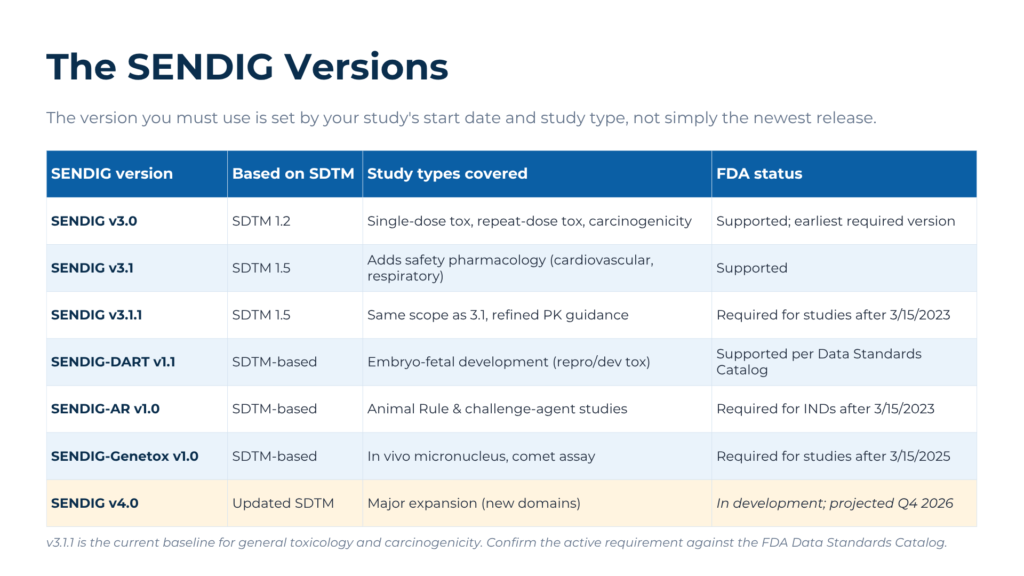
The SEND Implementation Guide comes in several versions and companion guides, and the one you must use is determined by your study’s start date and study type, not simply the newest release available. Using the wrong version, or mixing versions across a submission, is a common source of conformance findings.
Here is how the published guides compare.
| SENDIG version | Based on SDTM | Study types covered | FDA status |
|---|---|---|---|
| SENDIG v3.0 | SDTM 1.2 | Single-dose tox, repeat-dose tox, carcinogenicity | Supported; earliest required version |
| SENDIG v3.1 | SDTM 1.5 | Adds safety pharmacology (cardiovascular, respiratory) | Supported |
| SENDIG v3.1.1 | SDTM 1.5 | Same scope as 3.1, refined PK concentration/parameter guidance | Required for studies starting after 3/15/2023 |
| SENDIG-DART v1.1 | SDTM-based | Embryo-fetal development (reproductive/developmental tox) | Supported per Data Standards Catalog |
| SENDIG-AR v1.0 | SDTM-based | Animal Rule and challenge-agent studies | Required for INDs, studies after 3/15/2023 |
| SENDIG-Genetox v1.0 | SDTM-based | In vivo micronucleus, comet assay | Required for studies starting after 3/15/2025 |
| SENDIG v4.0 | Updated SDTM | Major expansion (new domains) | In development; publication projected Q4 2026 |
Version 3.1.1 is the current baseline for general toxicology and carcinogenicity work. Its refinements center on the pharmacokinetic concentration (PC) and parameter (PP) domains, tightening how timing variables are represented so reviewers can reconstruct time-concentration curves consistently.
Looking ahead, SENDIG v4.0 is the largest change on the horizon, with CDISC targeting a Q4 2026 final publication. It introduces new domains covering areas such as in vivo genetic toxicology, cell phenotyping, immunogenicity, and ophthalmology, and it revises existing domains like Microscopic Findings. Because dates and scope can shift during public review, always confirm the active requirement against the current FDA Data Standards Catalog before you lock a study’s approach. Tools that stay current with these rules, such as our eDataValidator for SEND, SDTM, and ADaM conformance, remove much of that version-tracking burden.
Not sure your datasets match the version the FDA expects?
Get a working proof of concept on your own study data and see exactly where it stands against current SENDIG and FDA rules.
FDA vs PMDA vs EMA: Global Adoption
As of 2026, the FDA is the only major regulator that mandates SEND for nonclinical study data. That single fact shapes most global submission strategies, and it is where many introductory guides get vague. Here is the accurate picture.
Japan’s PMDA requires CDISC standards for clinical data (SDTM and ADaM) and enforces its own set of validation rules, but it does not currently mandate SEND for nonclinical studies. The EMA encourages standardized data and participates in CDISC work, yet it does not require SEND submissions either. International harmonization discussions continue, so this may change, but today the practical requirement lives with the FDA.
For sponsors filing across regions, the takeaway is straightforward: build nonclinical data to SEND for the FDA, and validate clinical data against PMDA rules where Japan is in scope. Our validation tooling accounts for both, including PMDA validation rules alongside FDA and CDISC checks, so one workflow can serve multiple regulators.
How to Get SEND Datasets Right
Getting SEND right means three distinct jobs: building conformant datasets, validating them against the applicable rules, and reconciling the data against the study report. Skipping the third is the mistake that quietly derails otherwise clean submissions.
Build the datasets
Building SEND starts with mapping source data, whether it originates in a LIMS, an EDC system, collection tables, or a legacy PDF report, into the correct domains and controlled terminology. Accuracy here depends on disciplined data standardization rather than one-off conversions. PointCross approaches this through data standardization services that turn disparate source formats into conformant, submission-grade datasets with repeatable mappings.
Validate against FDA and CDISC rules
Validation is where submissions live or die at the gateway. The FDA enforces Technical Rejection Criteria (TRC) through automated eCTD checks, and a failure means the submission is rejected before a reviewer ever opens it. The high-severity codes to know are 1789 (a Study Tagging File must be present), 1734 (a Trial Summary ts.xpt dataset must exist for each study), 1735 (correct STF file tags), and 1736 (required dataset files present). These checks run in sequence, so an early failure stops the rest.
Beyond the TRC, your package must satisfy CDISC SEND Conformance Rules and the FDA-specific Business and Validator Rules, all documented in the Study Data Technical Conformance Guide (TCG). The TCG is revised regularly, and each update can change what your deliverables must include, as we broke down in our review of what the FDA’s TCG v6.2 update means for SEND deliverables. The authoritative source for all of it is the FDA Study Data Standards Resources page.
QC beyond the validator
A dataset can pass every conformance rule and still be wrong. Validators check structure and terminology; they do not confirm that your body-weight numbers, incidence tables, and findings actually match the signed study report. Reviewers do check that alignment, and discrepancies erode confidence in the whole submission.
This reconciliation step, comparing SEND datasets against the nonclinical study report record by record, is the difference between a technically valid file and a review-ready one. We cover the reasoning in detail in why passing the validator is only half the battle. Our SEND-ASSURE quality service automates that report-to-dataset consistency check, and pairing it with a digital study report workflow keeps data and narrative aligned from the start.
Common SEND Mistakes That Trigger Rejections
Most SEND problems fall into a short list of repeat offenders. Watching for them early saves the weeks a rejected submission costs.
- A missing or malformed ts.xpt. The Trial Summary file is the single most common cause of a 1734 rejection. Every study referenced in Modules 4 or 5 needs one, including studies with no full SEND package.
- Wrong SENDIG version for the study. Applying the newest guide to a study whose start date calls for an earlier version, or vice versa, produces conformance findings.
- Controlled terminology drift. Free-text or outdated terms where the standard expects a specific codelist value.
- Dataset-to-report mismatches. Numbers that pass the validator but disagree with the study report, which reviewers flag directly.
- Incomplete define.xml or a thin nSDRG. Metadata gaps and unexplained study-specific decisions slow review and invite questions.
Sponsors and CROs feeling this pain across a portfolio often centralize the work. Our overview of the SEND compliance challenges nonclinical CROs must solve maps these issues to concrete process fixes, and cross-study analysis becomes far easier once data lives in a nonclinical analytics warehouse.
Frequently Asked Questions
What is a SEND dataset?
A SEND dataset is a standardized, machine-readable file containing nonclinical (animal) study data, organized under the CDISC SEND standard. A submission includes multiple domain files (such as demographics, body weights, and histopathology) as .xpt files, plus a define.xml and a reviewer’s guide.
Who needs to submit SEND datasets to the FDA?
Sponsors submitting INDs, NDAs, ANDAs, or BLAs to CDER or CBER need SEND datasets for in-scope nonclinical studies. CROs typically generate the datasets, but the regulatory responsibility stays with the sponsor.
Which nonclinical studies require SEND?
Single-dose toxicity, repeat-dose toxicity, and carcinogenicity studies are the core in-scope types, along with cardiovascular and respiratory safety pharmacology. Additional types, including embryo-fetal development, Animal Rule, and certain genetic toxicology assays, are covered by companion guides with their own effective dates.
What is the difference between SEND and SDTM?
SDTM standardizes human clinical trial data; SEND standardizes nonclinical animal study data. SEND is built on the SDTM model and stays aligned with it, but its domains and variables reflect animal study design rather than human subjects.
What SENDIG version do I need to use?
The required version depends on your study’s start date and study type, matched against the FDA Data Standards Catalog. SENDIG v3.1.1 is the current baseline for general toxicology and carcinogenicity studies starting after March 15, 2023.
Do PMDA and EMA require SEND datasets?
Not as of 2026. Japan’s PMDA requires CDISC clinical standards (SDTM and ADaM) but not SEND for nonclinical data, and the EMA encourages standardized data without mandating SEND. The FDA is the only major regulator that requires it.
Ready to make SEND the easy part of your submission?
Whether you need datasets generated, an independent QC pass against your study reports, or a fast indicative quote, PointCross can get your nonclinical data review-ready and keep it that way across every filing.