

The FDA has rolled out version 6.2 of its Study Data Technical Conformance Guide, and if you sponsor nonclinical studies, it is worth understanding what changed before your next submission lands. Most of the update simply codifies practices that experienced SEND providers already follow – but there is one structural change that will affect how multi-phase studies are packaged, and it deserves a closer look.
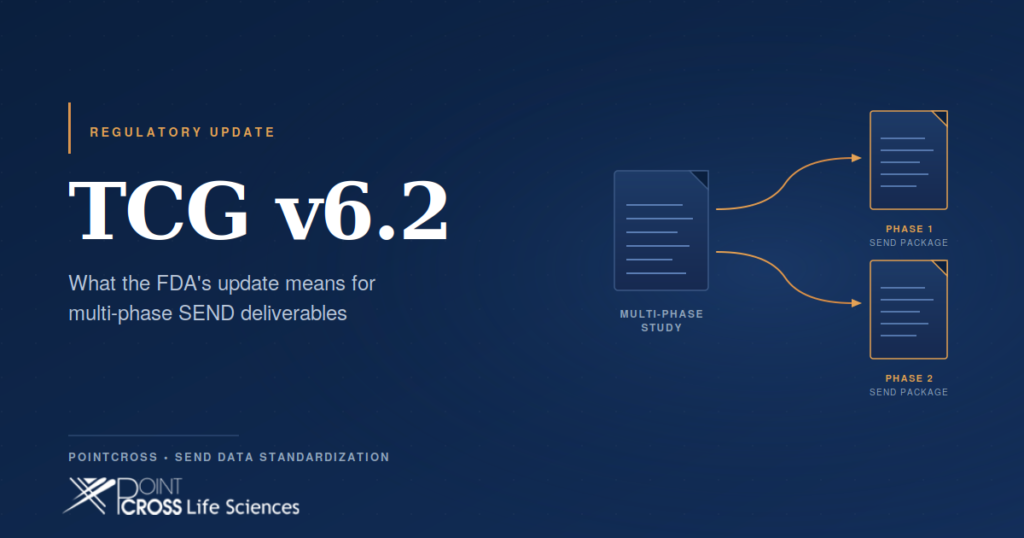
The Headline Change: Multi-Phase Studies Now Require Separate SEND Packages
The most consequential update concerns multi-phase studies – for instance, a maximum-tolerated dose (MTD) phase followed by a repeat-dose toxicity phase under the same protocol. Previously, sponsors had some flexibility in how those phases were bundled together for submission. Under TCG v6.2, the FDA now expects each phase to be delivered as its own standalone SEND package, with phase-specific datasets, a dedicated define.xml, and its own nonclinical Study Data Reviewer’s Guide (nSDRG).
In practice, this means cleaner separation between phases, more discrete deliverables per multi-phase program, and clearer traceability for FDA reviewers – but also more files moving through the SEND pipeline before submission.
What This Means for Your Pricing
We want to be upfront about how this affects costs, because nobody likes a surprise on an invoice.
Xbiom was built specifically for this kind of multi-phase complexity. Our pipeline can produce both packages efficiently without doubling the work behind the scenes – or doubling your costs. To put numbers on it:
- Regular toxicology studies: No change.
- All other study types: No change.
- Multi-phase studies: A modest adjustment to reflect the second deliverable, nothing more.
The bottom line: if your study program does not include multi-phase designs, your pricing stays exactly where it is. If it does, you’ll see a small uptick – not a doubling.
The Quieter Updates: Verification Practices Get Formalized
Beyond the multi-phase requirement, the bulk of TCG v6.2 codifies expectations around SEND data verification – specifically traceability, QC documentation, and group summary verification. The FDA has signaled these priorities for years through SBIA webinars, PHUSE working groups, and review feedback. Now those expectations are written down explicitly.
The good news for PointCross clients: every one of these verification practices is already part of our standard delivery, included at no additional cost. Traceability from raw data to submission datasets, documented QC at each handoff, and verification of group-level summaries against source reports – they are all baked in. If you have been working with us, your studies are already aligned with what TCG v6.2 now formally requires.
Talk to Us About Your Upcoming Studies
If you have a multi-phase study in your pipeline, or you simply want to walk through how v6.2 changes might affect a specific submission, our SEND team is happy to set up a working session. We can review the update in detail and answer questions specific to your program.
Reach out us here, and we will get a meeting on the calendar.
Further Reading
For sponsors who want to go deeper into the source material:
- FDA Study Data Standards Resources — The agency’s hub page linking to the current Technical Conformance Guide, the Data Standards Catalog, and FDA Business and Validator Rules.
- CDISC SEND Standard — Authoritative documentation on SEND Implementation Guides (SENDIG), including the latest version and supplemental therapeutic-area guides.
- PHUSE Nonclinical Study Data Reviewer’s Guide Working Group — The nSDRG template and ongoing community work that informs FDA-aligned reviewer guides.
- CDISC Foundational Standards Overview — Broader context on how SEND fits alongside SDTM, ADaM, and CDASH in the regulatory data landscape.