

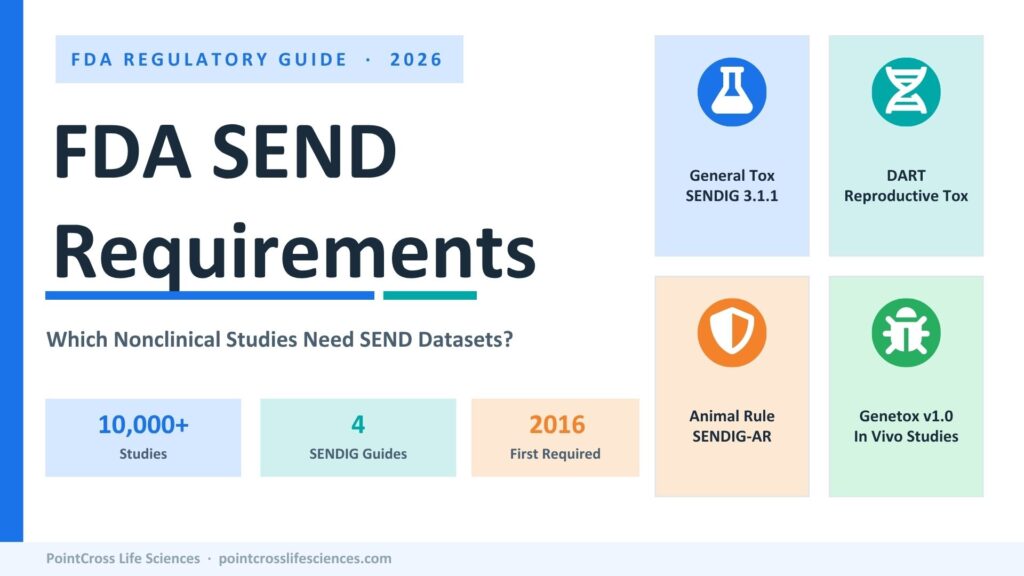
PointCross has prepared SEND datasets for more than 10,000 nonclinical studies and contributed to CDISC SEND Controlled Terminology development. This guide is grounded in Federal Register notices, the FDA Data Standards Catalog, and CDISC implementation guides – all cited at source.
Table of Contents
If you are a toxicologist, regulatory affairs lead, or CRO project manager preparing an IND or NDA submission package, one question comes up at nearly every planning meeting: which of my nonclinical studies actually need a SEND dataset?
The answer is not always a quick yes or no. FDA SEND requirements have expanded steadily since 2016, and the rules differ by study type, SENDIG version, submission type, and the FDA center receiving the dossier. Getting this wrong does not just create extra work. A noncompliant SEND dataset triggers a technical rejection from the FDA’s Electronic Submissions Gateway before a single reviewer reads a page, restarting the review clock and potentially delaying your program by weeks.
This guide covers every FDA SEND data requirement currently in effect as of May 2026, cites the Federal Register notices and FDA guidance documents that govern them, and gives you a clear decision process for determining SEND applicability before you finalize your Statement of Work with a CRO.
What Is SEND and Why Does the FDA Require It?
SEND (Standard for Exchange of Nonclinical Data) is a data submission standard developed by CDISC (Clinical Data Interchange Standards Consortium) and mandated by the FDA for nonclinical study data submitted in regulatory dossiers.
Before SEND, every CRO and sponsor delivered study data in its own proprietary format. FDA reviewers had to parse dozens of different report structures to extract the same information across compounds and studies. SEND creates a single, machine-readable, standardized structure that allows automated analysis regardless of which lab conducted the study or which software collected the data.
Practically, SEND datasets let FDA scientists use the agency’s Computational Science Center tools to compare safety signals across submissions, detect patterns in historical toxicology data, and conduct more efficient nonclinical reviews. This is why the requirement keeps expanding: SEND makes the FDA’s review process faster and more consistent, which benefits everyone in the development pipeline.
SEND vs SDTM: The One-Sentence Difference
SDTM (Study Data Tabulation Model) standardizes clinical trial data for eCTD Module 5. SEND standardizes nonclinical animal study data for eCTD Module 4. SEND is structurally derived from SDTM but includes domain-specific extensions for the complexities of animal experiments, including dosing, organ weights, histopathology, and endpoint-specific controlled terminology.
The Legal Basis for FDA SEND Requirements
The FDA’s authority to require standardized study data stems from the Federal Food, Drug, and Cosmetic Act. Operational requirements are detailed in the Study Data Technical Conformance Guide (TCG). Specific SEND version requirements are announced via Federal Register notices and formalized in the FDA Data Standards Catalog.
While FDA guidance documents are not regulations under 21 CFR, the FDA’s Electronic Submissions Gateway runs automated validation against SEND conformance rules before any human review takes place. Noncompliant datasets are technically rejected. In practice, FDA SEND requirements function as mandatory for any submission to which they apply.
Which Nonclinical Studies Require SEND Datasets?
In-Scope Study Types
Studies submitted to the following eCTD sections may require SEND datasets:
- 4.2.3.1 Single-Dose Toxicity: acute toxicity studies in rodent and non-rodent species
- 4.2.3.2 Repeat-Dose Toxicity: subacute, subchronic, and chronic toxicology studies
- 4.2.3.4 Carcinogenicity: 2-year rodent bioassays and 6-month transgenic mouse studies
- 4.2.1.3 Safety Pharmacology: cardiovascular (hERG, in vivo CV telemetry) and respiratory studies
- 4.2.3.5 Reproductive and Developmental Toxicity (EFD component): Embryo-Fetal Development studies, using SENDIG-DART v1.1
- 4.2.1.1 Animal Rule Natural History and Efficacy: studies supporting Animal Rule applications, using SENDIG-AR v1.0
- 4.2.3.3 In Vivo Genotoxicity: in vivo micronucleus and comet assays, using SENDIG-Genetox v1.0 (required for studies starting after March 15, 2025)
Studies Currently Out of Scope
The following study types are not currently subject to an FDA SEND requirement:
- In vitro studies (Ames test, in vitro micronucleus, in vitro ADME, mechanistic assays)
- Local tolerance studies in eCTD section 4.2.3.6
- Primary pharmacology studies in eCTD section 4.2.1.1 when not conducted under the Animal Rule
- PK/TK studies integrated into toxicology reports rather than submitted as standalone datasets
- Studies with start dates before the relevant effective date for their study type and submission category
The FDA’s Technical Rejection Criteria guidance document notes that SEND is currently required for single-dose toxicity, repeat-dose toxicity, carcinogenicity, CV and RE safety pharmacology studies, and Animal Rule natural history and efficacy studies. The automated TRC gateway checks currently apply specifically to Modules 4.2.3.1, 4.2.3.2, and 4.2.3.4.
If you are unsure whether a specific study falls in scope, PointCross offers complimentary study qualifications based on non-confidential study metadata, with no obligation.
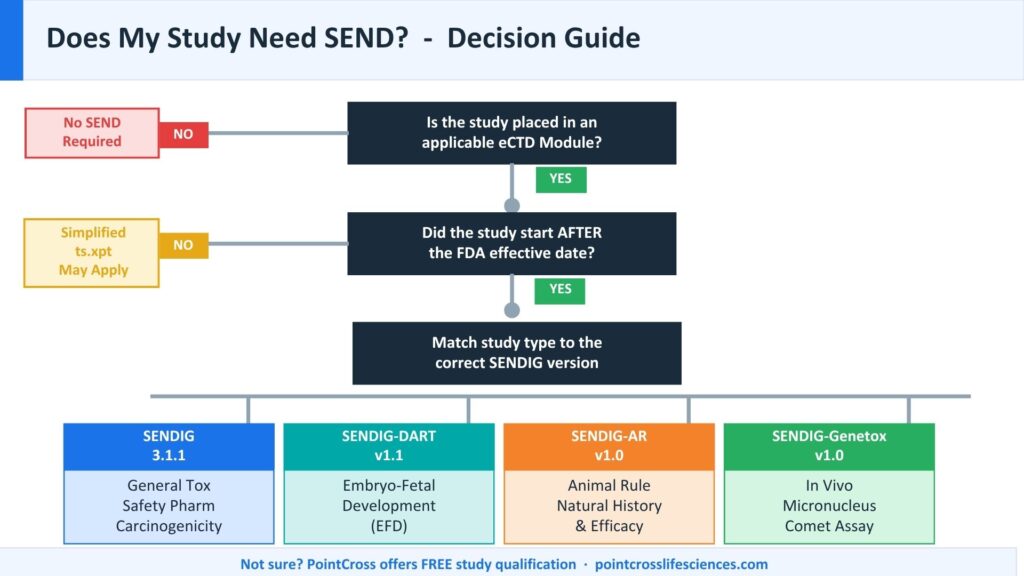
Does My Study Need SEND? A Six-Step Decision Process
Use this process before signing a Statement of Work. It mirrors the logic the FDA applies when reviewing submission packages.
Step 1: Identify the eCTD placement.
Determine which eCTD module and section the study report will occupy. SEND currently applies to studies placed in Modules 4.2.3.1, 4.2.3.2, 4.2.3.4, 4.2.1.3, 4.2.3.3, 4.2.3.5 (EFD component), and 4.2.1.1 (Animal Rule). If the study does not fall in any of these sections, SEND is not required.
Step 2: Confirm the receiving FDA center.
Is the submission going to CDER or CBER? Requirement effective dates differ by center. CBER requirements for several SENDIG versions began in 2023 and 2024, later than CDER.
Step 3: Confirm the submission type.
Note whether this is an IND, NDA, ANDA, or BLA. Requirement dates for each submission type were phased in separately by the FDA.
Step 4: Check the study start date.
The FDA SEND requirement is tied to the study start date (the protocol signature date), not the report finalization date or the submission date. A study started before the relevant effective date may not require a full SEND dataset, though it may still require a simplified ts.xpt file.
Step 5: Match the study type to the correct SENDIG.
General tox, carcinogenicity, and safety pharmacology use SENDIG 3.1.1. EFD studies use SENDIG-DART v1.1. Animal Rule studies use SENDIG-AR v1.0. In vivo genotoxicity studies use SENDIG-Genetox v1.0. Using the wrong implementation guide is a common source of conformance failures.
Step 6: Verify against the current FDA Data Standards Catalog.
Always cross-check against the latest version of the FDA Data Standards Catalog before locking the submission plan. Requirements are updated on a rolling basis, typically twice per year.
For edge cases, particularly studies that fall close to an effective-date boundary or involve combination designs spanning multiple SENDIG guides, working directly with an experienced SEND preparation team eliminates the guesswork. The FDA’s Study Data Technical Conformance Guide states: “The ideal time to implement SEND is prior to the conduct of the study.”
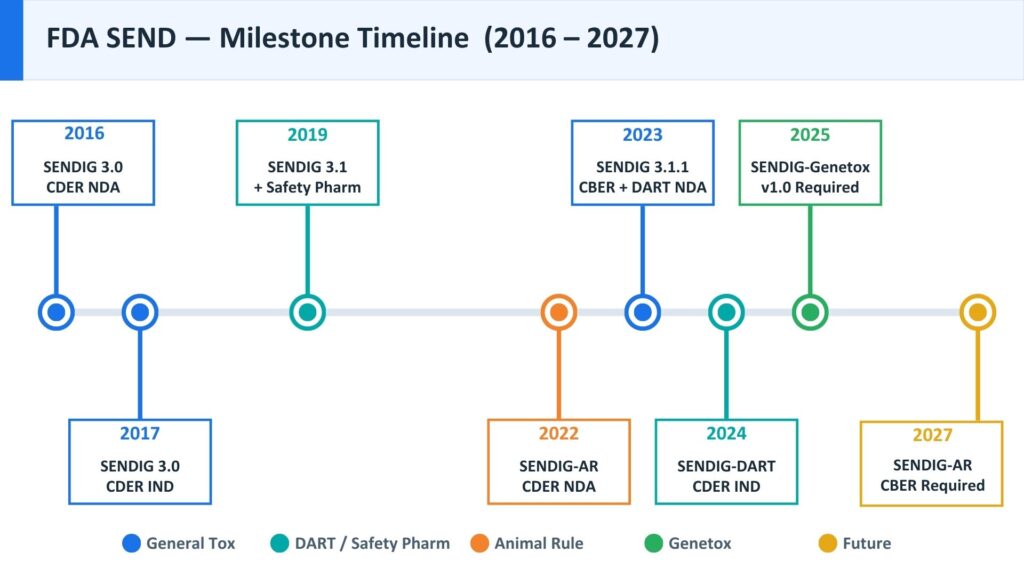
FDA SEND Requirement Dates by SENDIG, Center, and Submission Type
The table below consolidates requirement dates from Federal Register notices published through May 2026. All dates refer to study start dates (protocol signature dates), not submission dates. “Support begins” means the FDA will accept the format; “Requirement begins” means the FDA requires it for in-scope studies.
Sources: Federal Register 2022-03225 (Feb 15, 2022); Federal Register 2023-27310 (Dec 13, 2023); FDA Data Standards Catalog.
| SENDIG Version | Study Types Covered | FDA Center | Submission Types | Support Begins | Requirement Begins (Study Start Date) |
|---|---|---|---|---|---|
| SENDIG v3.0 (retired) | Single/Repeat-Dose Tox, Carcinogenicity | CDER | NDA/BLA/ANDA | Dec 17, 2016 | Dec 17, 2016 (ended Mar 15, 2019) |
| SENDIG v3.0 (retired) | Single/Repeat-Dose Tox, Carcinogenicity | CDER | Commercial IND | Dec 17, 2017 | Dec 17, 2017 (ended Mar 15, 2020) |
| SENDIG v3.1 (retired) | + CV and RE Safety Pharmacology | CDER | NDA/BLA | Mar 15, 2019 | Mar 15, 2019 (ended Mar 15, 2023) |
| SENDIG v3.1 (retired) | + CV and RE Safety Pharmacology | CDER | IND | Mar 15, 2020 | Mar 15, 2020 (ended Mar 15, 2023) |
| SENDIG v3.1.1 (current) | Single/Repeat-Dose Tox, Carcinogenicity, CV/RE Safety Pharm | CDER | NDA/ANDA/IND/BLA | Feb 15, 2022 | Mar 15, 2023 |
| SENDIG v3.1.1 (current) | Single/Repeat-Dose Tox, Carcinogenicity, CV/RE Safety Pharm | CBER | NDA/ANDA/IND/BLA | Mar 15, 2023 | Mar 15, 2023 |
| SENDIG-DART v1.1 | Embryo-Fetal Development (EFD) studies | CDER | NDA/BLA/ANDA | Mar 15, 2022 | Mar 15, 2023 |
| SENDIG-DART v1.1 | Embryo-Fetal Development (EFD) studies | CDER | IND | Mar 15, 2023 | Mar 15, 2024 |
| SENDIG-DART v1.1 | EFD studies | CBER | All | Not yet required by CBER | Not yet required by CBER |
| SENDIG-DART v1.2 | EFD + Juvenile Animal Tox | CDER / CBER | All | Published by CDISC (June 2023) — not yet supported or required by FDA | — |
| SENDIG-AR v1.0 | Animal Rule: Natural History and Efficacy | CDER | NDA/BLA | Mar 15, 2021 | Mar 15, 2022 |
| SENDIG-AR v1.0 | Animal Rule: Natural History and Efficacy | CDER | IND | Mar 15, 2022 | Mar 15, 2023 |
| SENDIG-AR v1.0 | Animal Rule: Natural History and Efficacy | CBER | NDA/IND/BLA | Mar 26, 2024 | Mar 15, 2027 |
| SENDIG-Genetox v1.0 | In Vivo Micronucleus, In Vivo Comet Assay | CDER and CBER | NDA/ANDA/IND/BLA | Dec 13, 2023 | Mar 15, 2025 |
| Define-XML v2.1 | All SEND packages (metadata file) | CDER and CBER | All | Mar 15, 2022 | Mar 15, 2023 |
Are SEND Datasets Required for Non-GLP Studies?
Yes. GLP status does not exempt a study from FDA SEND requirements.
This is one of the most frequently misunderstood aspects of the SEND requirement. The FDA SEND obligation is determined entirely by three factors: what type of study it is, where it falls in the eCTD structure, and when it was started. GLP compliance plays no role in this determination.
The logic is straightforward: both GLP and non-GLP nonclinical studies can be submitted to support clinical safety assessments. The FDA needs standardized, machine-readable data regardless of the lab’s GLP status. A non-GLP exploratory repeat-dose study placed in Module 4.2.3.2 and started after March 15, 2023 requires a SENDIG 3.1.1-compliant dataset when submitted to CDER.
Draft, Interim, and Final Reports: All Require SEND
Report status does not determine SEND applicability. The FDA’s Study Data Technical Conformance Guide states that the SEND requirement applies regardless of whether the study report is a draft, an interim report, or a final report. If a draft or interim report for an in-scope study is included in a submission, the SEND dataset must accompany it.
This matters in practice for programs that include an interim toxicology report in an IND submission while the study is still ongoing. The SEND dataset for that interim data must be prepared and validated to the same standard as a final dataset.
What Is in a SEND Submission Package?
A complete SEND submission package has three required components.
The SEND Dataset Files (.xpt)
SEND datasets are collections of SAS XPT files, each representing a different data domain. Common domains include TS (Trial Summary), TX (Trial Sets), DM (Demographics), EX (Exposure), BW (Body Weights), CL (Clinical Observations), LB (Laboratory Results), MI (Microscopic Findings), MA (Macroscopic Findings), OM (Organ Measurements), PC (Pharmacokinetics Concentrations), and PP (Pharmacokinetic Parameters). Additional domains apply depending on study type, such as GV for SENDIG-Genetox, or DD (Death Details) and DP (Developmental Milestones) for SENDIG-DART.
Define-XML v2.1
Define-XML is a machine-readable metadata file (in XML format) that describes every dataset, every variable, and the controlled terminology used in the SEND package. Define-XML v2.1 is required for all SEND submissions to CDER and CBER for studies starting after March 15, 2023. Define-XML v2.0 is no longer accepted for new in-scope submissions.
The Nonclinical Study Data Reviewer’s Guide (nSDRG)
The nSDRG is a plain-language narrative document that guides FDA reviewers through the SEND dataset. It describes the study design, any deviations from SEND standards, and how to navigate the data domains. The PhUSE nonclinical working group publishes a standard nSDRG template. An nSDRG that is incomplete or inconsistent with the dataset is a common contributor to FDA information requests.
The Simplified ts.xpt for Edge-Case Studies
For studies that fall near the effective-date boundaries but do not require a full SEND dataset, the FDA may still require a simplified ts.xpt file, which is a minimal version of the Trial Summary domain. The TCG specifies the criteria for these cases. PointCross’s SEND preparation team can assess whether your study requires the full package, a simplified ts.xpt, or neither.
The SENDIG Family: Which Implementation Guide Applies?
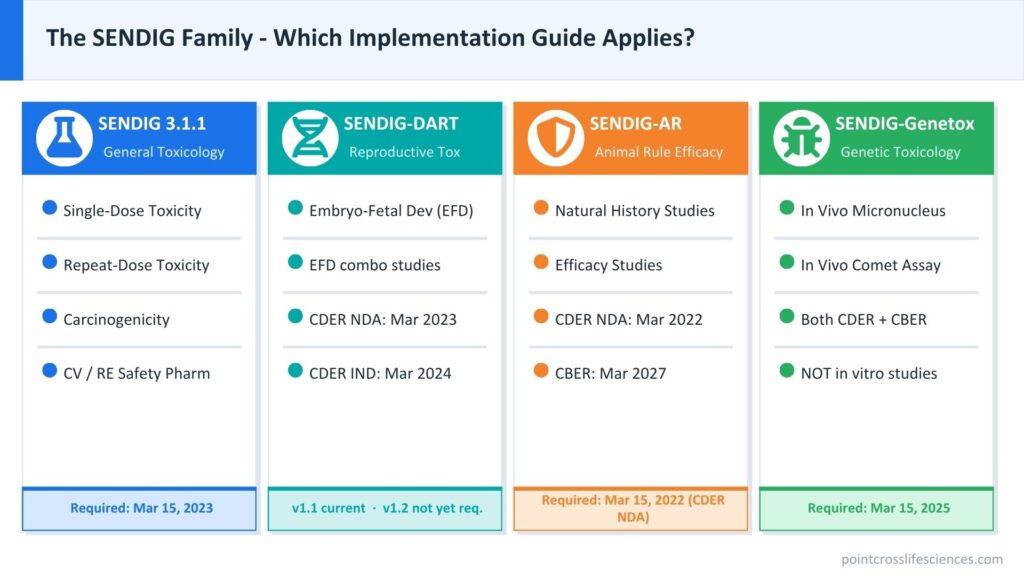
SENDIG v3.1.1 (General Toxicology, Carcinogenicity, Safety Pharmacology)
SENDIG v3.1.1 is the current standard for most general toxicology submissions. It applies to single-dose and repeat-dose toxicity studies, carcinogenicity bioassays, and cardiovascular or respiratory safety pharmacology studies. Per Federal Register notice 2022-03225, the requirement for SENDIG 3.1.1 began March 15, 2023 for CDER and CBER across NDA, ANDA, IND, and BLA submissions. SENDIG 3.0 and SENDIG 3.1 are now retired.
SENDIG-DART v1.1 (Embryo-Fetal Development Studies)
SENDIG-DART v1.1 covers Embryo-Fetal Development (EFD) studies and the EFD portions of combination reproductive toxicology studies. For CDER NDA submissions, the requirement began March 15, 2023. For CDER IND submissions, the requirement began March 15, 2024. CBER has not yet issued a requirement for SENDIG-DART.
One important clarification: juvenile animal toxicology studies are submitted using standard SENDIG 3.1.1, not SENDIG-DART. Only EFD-specific data falls under the DART implementation guide. SENDIG-DART v1.2 was published by CDISC in June 2023 and includes coverage for juvenile animal studies, but the FDA has not announced support or a requirement date for v1.2. Sponsors should use SENDIG-DART v1.1 for all current EFD submissions.
SENDIG-AR v1.0 (Animal Rule Studies)
SENDIG-AR v1.0 applies to natural history and efficacy studies conducted under the FDA’s Animal Rule for drugs intended to counter chemical, biological, radiological, or nuclear threats. For CDER NDA submissions, the requirement began March 15, 2022. For CDER IND submissions, the requirement began March 15, 2023. CBER support began March 26, 2024, with the CBER requirement date set for March 15, 2027.
SENDIG-Genetox v1.0 (In Vivo Genetic Toxicology)
SENDIG-Genetox v1.0 is the newest required implementation guide. Per Federal Register notice 2023-27310, FDA support began December 13, 2023, and the requirement took effect March 15, 2025 for CDER and CBER NDA, ANDA, IND, and BLA submissions. In vivo micronucleus assays and in vivo comet assays are the most common study types affected. In vitro genotoxicity assays (Ames test, in vitro micronucleus) are not covered by SENDIG-Genetox.
Sponsors with in vivo genotoxicity studies that started after March 15, 2025 must include a SENDIG-Genetox v1.0-compliant dataset in their submissions. PointCross’s SEND dataset preparation services include full SENDIG-Genetox support.
Looking Ahead: SENDIG v4.0
CDISC opened the public review period for SENDIG v4.0 on April 6, 2026, targeting a June 2026 publication date. SENDIG v4.0 is a major revision that introduces significant structural changes, including improved support for combination studies, enhanced histopathology domains, and alignment with Dataset-JSON. The FDA has not yet announced a support or requirement date for SENDIG v4.0. Sponsors running long-duration studies expected to complete in late 2026 or 2027 should monitor the FDA Data Standards Catalog for updates.
eCTD Placement and the FDA Technical Rejection Criteria
Where SEND Lives in an eCTD Submission
SEND datasets are submitted in the Study Tagging Files (STF) of Module 4 of the eCTD. Each study report is cross-referenced to its accompanying SEND dataset via the study reference file. The SEND package sits in a dedicated data folder alongside the study report, and both are referenced in the Module 4 backbone.
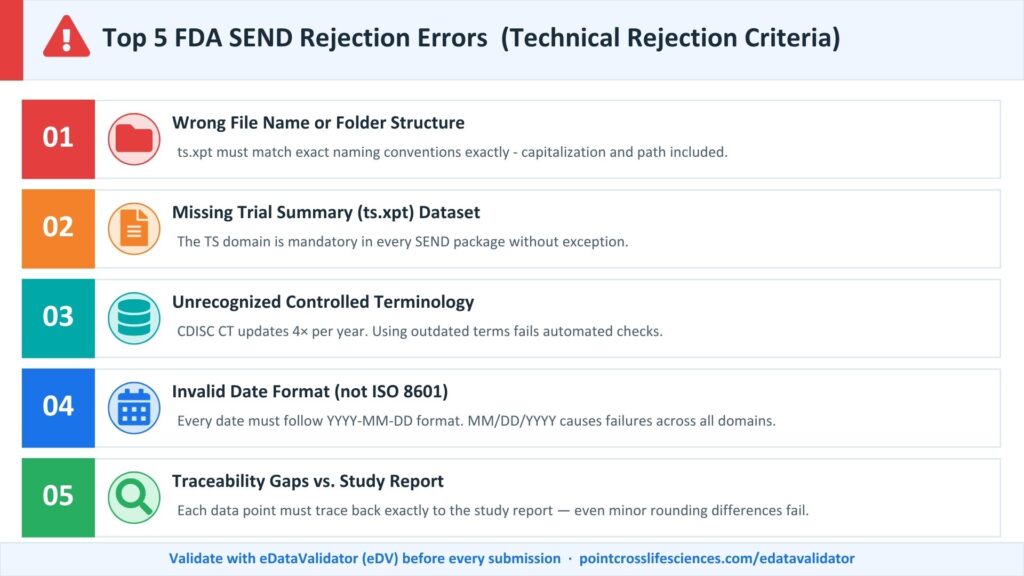
The Five Most Common Technical Rejection Criteria Failures
The FDA’s Electronic Submissions Gateway runs automated conformance checks before any reviewer sees a submission. Datasets that fail are rejected at this stage. The most frequently encountered TRC failures in SEND datasets are:
- Incorrect file naming or folder structure. SEND dataset files must follow specific naming conventions (for example, ts.xpt, dm.xpt). Deviations, including capitalization differences, cause automated rejection.
- Missing TS (Trial Summary) dataset. The TS domain is required in every SEND package. An absent or malformed ts.xpt is a TRC failure regardless of the quality of other domains.
- Unrecognized controlled terminology. SEND uses CDISC Controlled Terminology (CT). Terms not found in the current FDA-required CT version trigger conformance errors. CT is updated four times per year, and using an outdated CT version is a common trap.
- Invalid ISO 8601 date formats. All dates and times in SEND must conform to ISO 8601. Dates formatted as MM/DD/YYYY rather than YYYY-MM-DD generate conformance failures across every domain they appear in.
- Traceability gaps between dataset and study report. The FDA requires that every data point in the SEND dataset be traceable to its source in the study report. Discrepancies — even minor ones such as a body weight value that differs by a rounding digit — can trigger information requests.
PointCross uses its proprietary eDataValidator (eDV) to validate every SEND dataset against CDISC, FDA, and PMDA conformance rules before delivery. For CROs or sponsors who have already prepared a dataset and want independent validation before submission, SEND ASSURE provides a full QC review including digitized reconciliation against the study report.
Beyond the FDA: EMA SEND Proof-of-Concept and PMDA Status
EMA SEND Proof-of-Concept (2025 to Present)
The European Medicines Agency (EMA) published a Q&A document on June 16, 2025, describing a proof-of-concept study to evaluate whether SEND datasets can improve the efficiency of initial centralised marketing authorisation reviews. Participation in the PoC is voluntary for sponsors submitting to EMA. As of May 2026, EMA has not issued a mandatory SEND requirement. Sponsors preparing global dossiers should monitor the EMA SEND PoC landing page for updates.
PMDA (Japan)
As of May 2026, no official PMDA-issued document has been publicly verified confirming a mandatory or formal voluntary SEND policy for submissions to Japan’s Pharmaceuticals and Medical Devices Agency. Sponsors with PMDA submissions should consult directly with the agency or a qualified regulatory affairs professional rather than relying on secondary sources.
Future of SEND: v4.0 and Dataset-JSON
The current XPT format (SAS XPORT Transport file, Version 5) that carries SEND datasets has structural limitations: it supports a maximum of 8-character variable names and 200-character variable labels, which increasingly constrains complex modern datasets. The FDA is actively evaluating Dataset-JSON v1.1 as a successor format.
On April 9, 2025, the FDA published a Federal Register notice (Docket FDA-2025-N-0129) requesting public comments on adopting Dataset-JSON as the standard for electronic study data submission. While XPT remains the required format as of May 2026, this notice signals the long-term direction. Sponsors investing in data infrastructure should plan for Dataset-JSON compatibility.
For analysis of what SENDIG v4.0 changes mean for your program, visit the PointCross Nonclinical Resources library.
Frequently Asked Questions About FDA SEND Requirements
Which nonclinical studies require SEND datasets?
Nonclinical studies submitted under eCTD Modules 4.2.3.1 (single-dose toxicity), 4.2.3.2 (repeat-dose toxicity), 4.2.3.4 (carcinogenicity), 4.2.1.3 (CV and RE safety pharmacology), 4.2.3.3 (in vivo genotoxicity via SENDIG-Genetox), 4.2.3.5 (EFD component via SENDIG-DART), and 4.2.1.1 (Animal Rule via SENDIG-AR) require SEND datasets when the study start date falls after the relevant FDA effective date.
Are SEND datasets required for non-GLP studies?
Yes. GLP status does not determine SEND applicability. Both GLP and non-GLP studies require SEND datasets if they meet the study type, eCTD placement, and study start date criteria. The FDA’s Study Data Technical Conformance Guide is explicit on this point.
When did FDA start requiring SEND?
The FDA first required SEND for CDER NDA submissions on December 17, 2016 (SENDIG 3.0). CDER IND submissions followed on December 17, 2017. SENDIG 3.1.1 became required for CDER and CBER submissions starting March 15, 2023. CBER requirements began March 15, 2023 across all submission types.
Is SEND required for IND submissions?
Yes. CDER IND submissions have required SEND since December 17, 2017. CBER IND submissions have required SEND since March 15, 2023. SENDIG 3.1.1 applies to both centers for studies starting after March 15, 2023.
Do draft or interim study reports require SEND?
Yes. Report status (draft, interim, or final) does not affect the SEND requirement. If a draft or interim report is submitted to the FDA and the study is in scope, a SEND dataset must be included.
What is the difference between SENDIG 3.1 and SENDIG 3.1.1?
SENDIG 3.1.1 is a minor corrective revision of SENDIG 3.1, addressing errata and controlled terminology clarifications. SENDIG 3.1 is now retired for new submissions. The requirement for SENDIG 3.1.1 began March 15, 2023 for CDER and CBER.
What eCTD modules require SEND datasets?
SEND is currently required for studies placed in Modules 4.2.3.1, 4.2.3.2, 4.2.3.4, 4.2.1.3, 4.2.3.3 (in vivo genotox), 4.2.3.5 (EFD portion), and 4.2.1.1 (Animal Rule). The FDA’s automated Technical Rejection Criteria checks currently focus on Modules 4.2.3.1, 4.2.3.2, and 4.2.3.4.
What is SENDIG-DART and when is it required?
SENDIG-DART v1.1 is required for Embryo-Fetal Development studies submitted to CDER: NDA requirement from March 15, 2023; IND requirement from March 15, 2024. CBER has not yet issued a SENDIG-DART requirement. SENDIG-DART v1.2 is published by CDISC but not yet supported or required by the FDA.
What is SENDIG-Genetox and when did it become required?
SENDIG-Genetox v1.0 applies to in vivo genotoxicity studies including in vivo micronucleus and comet assays. The FDA requirement took effect March 15, 2025 for CDER and CBER NDA, ANDA, IND, and BLA submissions. In vitro genotoxicity studies are not covered.
What is SENDIG-AR and when is it required?
SENDIG-AR v1.0 covers Animal Rule natural history and efficacy studies. CDER NDA requirement from March 15, 2022; CDER IND from March 15, 2023. CBER support began March 26, 2024, with CBER requirement beginning March 15, 2027.
What is in a complete SEND submission package?
A complete SEND package includes the SEND dataset XPT files (domains such as TS, TX, DM, EX, BW, CL, LB, MI, MA, OM, PC, PP, and others depending on study type), a Define-XML v2.1 metadata file, and the Nonclinical Study Data Reviewer’s Guide (nSDRG). Studies near effective-date boundaries may require a simplified ts.xpt file instead of the full package.
What is Define-XML and is it required for SEND?
Define-XML v2.1 is a machine-readable metadata file describing the structure and controlled terminology of the SEND dataset. It has been required for all in-scope SEND submissions to CDER and CBER for studies starting after March 15, 2023. Define-XML v2.0 is no longer accepted for new in-scope submissions.
What is the FDA Technical Rejection Criteria for SEND?
The TRC are automated gateway checks run before human review. Common TRC failures include incorrect file naming, missing TS datasets, non-standard controlled terminology, invalid ISO 8601 dates, and dataset-to-study-report traceability gaps. Datasets failing TRC are rejected before the review clock starts.
What is the difference between SEND and SDTM?
SDTM standardizes clinical trial data for eCTD Module 5. SEND standardizes nonclinical animal study data for eCTD Module 4. SEND is derived from SDTM but includes domain-specific extensions for animal toxicology endpoints.
Does EMA require SEND?
As of May 2026, EMA does not require SEND. EMA published a Q&A document on June 16, 2025 describing a voluntary proof-of-concept study for SEND adoption in centralized marketing authorization applications.
Does PMDA require SEND?
As of May 2026, no verified PMDA primary document confirms a mandatory or formal voluntary SEND policy. Sponsors should consult directly with PMDA or a qualified regulatory affairs specialist for current guidance on Japanese submissions.
When will SENDIG v4.0 be required?
CDISC opened the SENDIG v4.0 public review on April 6, 2026, targeting June 2026 publication. The FDA has not yet announced a support or requirement date. Existing submissions should continue to use SENDIG 3.1.1.
What is Dataset-JSON and will it replace XPT for SEND?
Dataset-JSON v1.1 is a modern JSON-based format designed to overcome the limitations of the SAS XPT format. The FDA published a Federal Register notice in April 2025 (Docket FDA-2025-N-0129) requesting comments on adopting Dataset-JSON. XPT remains required as of May 2026, but Dataset-JSON is the expected long-term direction for SEND file formats.
Key Takeaways
- FDA SEND requirements for nonclinical studies have been in effect since 2016 for CDER and 2023 for CBER, and the scope continues to expand with new implementation guides.
- GLP status and report status (draft, interim, or final) do not affect the SEND requirement. Applicability is determined by study type, eCTD placement, and study start date.
- Four SENDIG implementation guides are currently required: SENDIG 3.1.1, SENDIG-DART v1.1, SENDIG-AR v1.0, and SENDIG-Genetox v1.0.
- SENDIG-Genetox v1.0 became required on March 15, 2025. Any in vivo micronucleus or comet assay study starting after that date and submitted to CDER or CBER requires a compliant dataset.
- Define-XML v2.1 is required for all in-scope SEND packages for studies starting after March 15, 2023.
- SENDIG v4.0 is in public review as of April 2026. No FDA requirement date has been announced.
- The FDA is evaluating Dataset-JSON v1.1 as a future successor to the XPT format. XPT remains required for now.
- SEND planning should start at the study design phase, before protocol finalization, not after the final report is issued.
Not Sure Whether Your Study Needs SEND? Get a Free Assessment.
PointCross Life Sciences has prepared SEND datasets for more than 10,000 nonclinical studies. Our Data Standardization team can confirm in writing whether a specific study requires a full SEND dataset, a simplified ts.xpt, or neither – at no charge and with no confidential data required.
In line with our commitment to pricing transparency, PointCross provides a firm, fixed-price quote with a guaranteed turnaround time at no cost and without obligation, via our SEND Quote Generator.
Get a Free Indicative SEND Quote | SEND ASSURE: Independent Dataset QC | Contact the SEND Team
Email: [email protected] | Toll-Free: +1 (844) 382-7257
References and Further Reading
- FDA Data Standards Catalog (current version)
- FDA Study Data Technical Conformance Guide
- FDA Study Data Technical Rejection Criteria (TRC) Guidance
- Federal Register 2022-03225: SENDIG 3.1.1 Requirement (Feb 15, 2022)
- Federal Register 2023-27310: SENDIG-Genetox and SDTM v2.0 (Dec 13, 2023)
- Federal Register 2025-06051: Dataset-JSON Request for Comments (Apr 9, 2025)
- CDISC SEND Implementation Guides (all versions)
- EMA SEND Proof-of-Concept Study (Q&A published June 16, 2025)
- PointCross Nonclinical Resources: SEND Whitepapers, Webinars, and Technical Guides
This article was written by the PointCross Life Sciences Data Standardization Team, which has contributed to CDISC SEND Controlled Terminology development and has prepared SEND datasets for more than 10,000 nonclinical studies across SENDIG 3.1.1, SENDIG-DART, SENDIG-AR, and SENDIG-Genetox. Content reflects regulatory requirements as of May 20, 2026. Always verify against the current FDA Data Standards Catalog before finalizing a submission plan.