

Table of Contents
SEND compliance challenges cost nonclinical CROs time, money, and submission credibility, and the five biggest ones are evolving standards, validation and conformance errors, dataset-to-report consistency, the nSDRG authoring burden, and tight timelines against rising study volume. The Standard for Exchange of Nonclinical Data (SEND) is no longer optional for in-scope toxicology work, and the U.S. FDA enforces it through automated gateway checks that can reject a submission before a reviewer ever opens it. For contract research organizations preparing data on behalf of sponsors, getting SEND right is now a core deliverable, not a back-office formality.
This article breaks down the real SEND compliance challenges that nonclinical CROs face, grounded in current FDA and CDISC requirements, and shows where disciplined process and the right tooling change the outcome. We write this for toxicologists, regulatory affairs professionals, bioinformaticians, pharma and biotech executives, and the IT and data teams who live with these datasets every day.
What SEND Compliance Actually Requires Today
SEND compliance means submitting nonclinical study data in CDISC’s standardized tabulation format, with the correct implementation guide version, a Define-XML metadata file, and a nonclinical Study Data Reviewer’s Guide (nSDRG). The FDA mandates this under Section 745A(a) of the Federal Food, Drug, and Cosmetic Act, and the required versions live in the FDA Data Standards Catalog.
As of mid-2026, the operative requirements are clear. SENDIG v3.1.1 is the current general-toxicology and carcinogenicity standard, required for studies with start dates after March 15, 2023. SENDIG-DART v1.1 covers embryo-fetal development studies (NDA requirement from March 15, 2023; IND from March 15, 2024). SENDIG-Genetox v1.0 brought in vivo micronucleus and comet assays into scope, required for studies starting on or after March 15, 2025. Define-XML v2.1 is required for all SEND packages for studies starting after March 15, 2023.
A complete SEND package includes the dataset XPT files (domains such as TS, TX, DM, EX, BW, CL, LB, MA, MI, OM, PC, PP, depending on study type), the Define-XML v2.1 file, and the nSDRG. Miss any required piece, or use a non-supported version, and the application risks a refuse-to-file action. The FDA also publishes the Study Data Technical Conformance Guide (current technical specifications document dated March 27, 2025) plus FDA Business Rules (v1.5, May 2019) and Validator Rules (v1.6, December 2022) that codify what “conformant” means in practice.
The point for CROs: SEND is a moving target governed by multiple documents that update on independent schedules. That sets up the first challenge.
Turn SEND requirements into a repeatable, audit-ready workflow
PointCross prepares submission-ready SEND datasets across general tox, carcinogenicity, DART, and genetic toxicology, mapped from your source data with full traceability to the study report.
Challenge 1: Evolving SENDIG Versions and Controlled Terminology
The single hardest part of staying compliant is that the standard never stops moving. New implementation guides, new controlled terminology, and new FDA requirement dates arrive on a rolling basis, and the version you must use depends on each study’s start date.
Consider the active version map a CRO must track simultaneously:
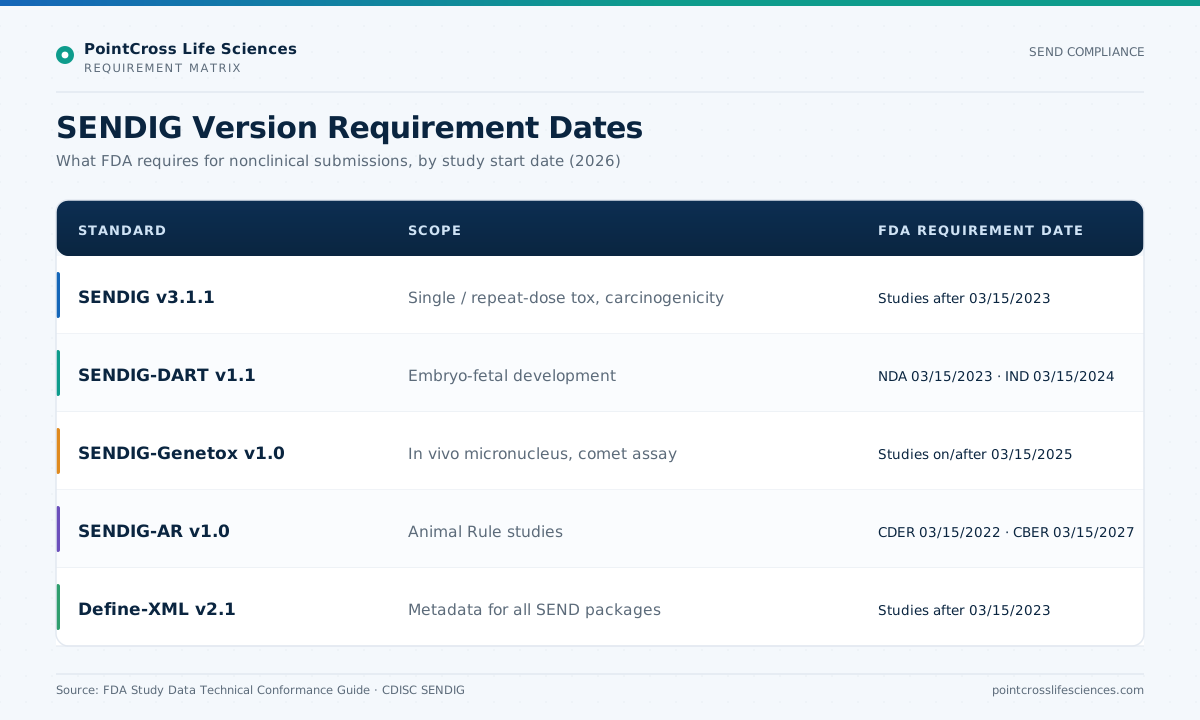
| Standard | Scope | FDA requirement date |
|---|---|---|
| SENDIG v3.1.1 | Single/repeat-dose tox, carcinogenicity | Studies started after 3/15/2023 |
| SENDIG-DART v1.1 | Embryo-fetal development | NDA 3/15/2023; IND 3/15/2024 |
| SENDIG-Genetox v1.0 | In vivo micronucleus, comet assay | Studies on/after 3/15/2025 |
| SENDIG-AR v1.0 | Animal Rule studies | CDER NDA 3/15/2022; CBER 3/15/2027 |
| Define-XML v2.1 | Metadata for all SEND packages | Studies after 3/15/2023 |
On top of versioning, CDISC SEND Controlled Terminology is published quarterly by the National Cancer Institute’s Enterprise Vocabulary Services (NCI-EVS). Each release adds new terms, modifies existing submission values, and retires others, with a published change log mapping retired terms to replacements. A test code or finding term that was valid last quarter may be deprecated this quarter, and the Define-XML must reference the exact controlled terminology version used. For a CRO running dozens of concurrent studies started under different SENDIG versions, this becomes a configuration-management problem at scale.
Looking ahead, SEND 4.0 is in development at CDISC and will add roughly eight new domains covering in vivo genetic toxicology, cell phenotyping, immunogenicity, ophthalmology, nervous system tests, skin tests, pharmacokinetic inputs, and scoring scales, while deprecating domains like Tumor Findings (TF) and Bodyweight Gains (BG). Per Certara’s analysis, “Based on a timetable shared in January 2025 by the CDISC SEND team, the current target date for publication of SEND 4.0 is June 2026,” and the date has slipped before. Even after CDISC publishes, history shows a substantial lag to enforcement: Certara notes it “could take 1-2 years or more from the time FDA is able to accept data formatted using a new standard to when it becomes a requirement.” CROs that bolt SEND on at the end of a study will feel every one of these changes as rework. (Teams managing many studies across versions often centralize this in a metadata repository; learn more about the XBIOM UDM unified data repository.)
Challenge 2: Validation Errors, Conformance, and FDA Rejection Risk
The most concrete SEND compliance challenge is passing validation, because the FDA enforces a set of Technical Rejection Criteria automatically at the electronic submission gateway. A submission that fails a high-severity check is rejected before scientific review begins, and the FDA began this automated rejection on September 15, 2021.
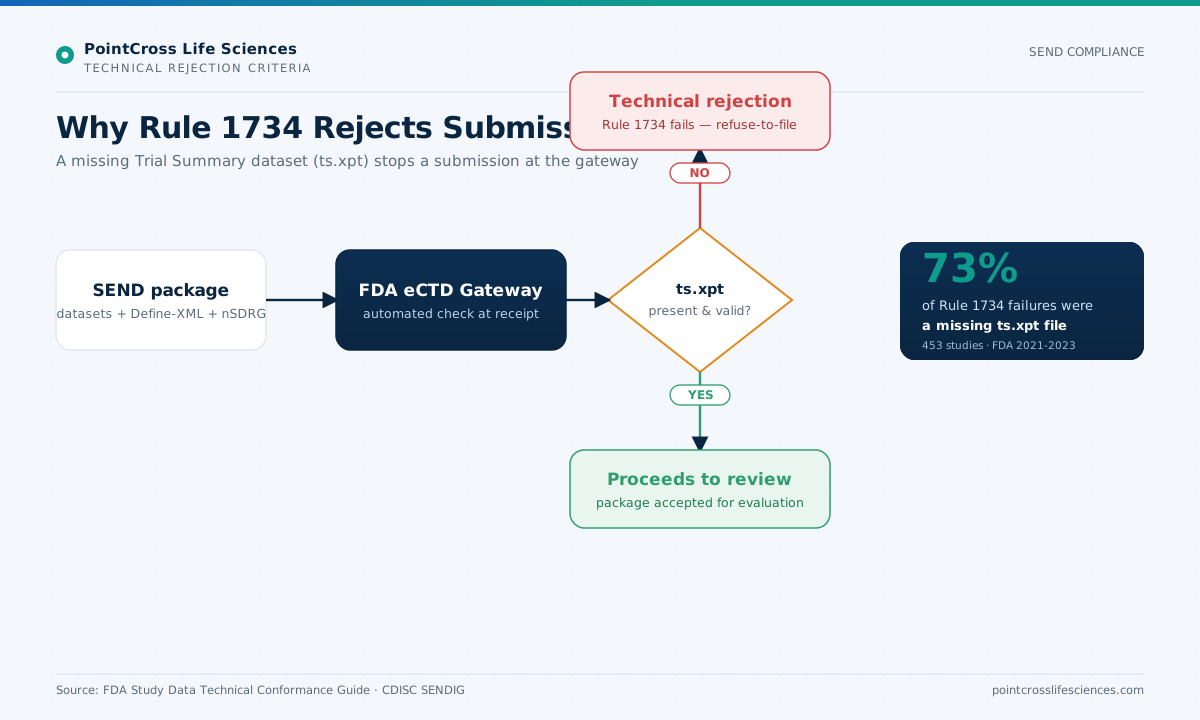
The criteria include four high-severity validation rules: 1734 (a ts.xpt with study start date must be present for each study), 1735 (correct STF file-tags for all standardized datasets and Define-XML files), 1736 (DM dataset and Define-XML in the correct eCTD module — Module 4 for SEND), and 1789 (study files referenced in a Study Tagging File). Rule 1734 is the single most common rejection reason, and it disproportionately hits nonclinical submissions.
The FDA’s own numbers make the case. According to the agency’s SEND F2F Spring 2023 presentation, between September 15, 2021 and February 15, 2023, 453 IND, NDA, and BLA nonclinical studies failed Rule 1734; 73% (329 of 453) failed simply due to a missing ts.xpt file, and 71% (322 of 453) were repeat-dose toxicology studies. Across 2020–2022 the same FDA trend data show Rule 1734 accounted for roughly 51–61% of all nonclinical study errors quarter over quarter. These are not exotic scientific problems; they are avoidable structural and packaging errors. A misformatted ISO 8601 study start date, a missing Trial Summary dataset, or a study ID mismatch is enough to bounce an entire submission. (Note: as of March 16, 2023, the STUDYID match between ts.xpt and the Study Tagging File moved to a new medium-severity Rule 1738, but a missing or invalid ts.xpt under 1734 remains a hard rejection.)
Beyond the gateway, CROs must clear CDISC SEND Conformance Rules plus the FDA Business Rules and Validator Rules, typically checked with tools like Pinnacle 21 or PointCross’s own validator. Community-grade validation tools introduce their own friction: inconsistent rule-set and engine versions across users, no central audit trail, and false positives that consume reviewer time. The discipline of validating early, often, and against the correct FDA engine version separates clean submissions from rejected ones (validate SDTM, ADaM, SEND, and Define-XML with the eDataValidator conformance tool).
A connecting reality for decision-makers: every rejection cycle adds weeks and burns sponsor goodwill. If you want to see how automated, FDA-rule-aware validation and correction shortens that cycle, talk to the team directly.
Ready to stop guessing whether your datasets will clear the gateway? Request a Free Demo
Challenge 3: Dataset-to-Study-Report Consistency and Source Data Quality
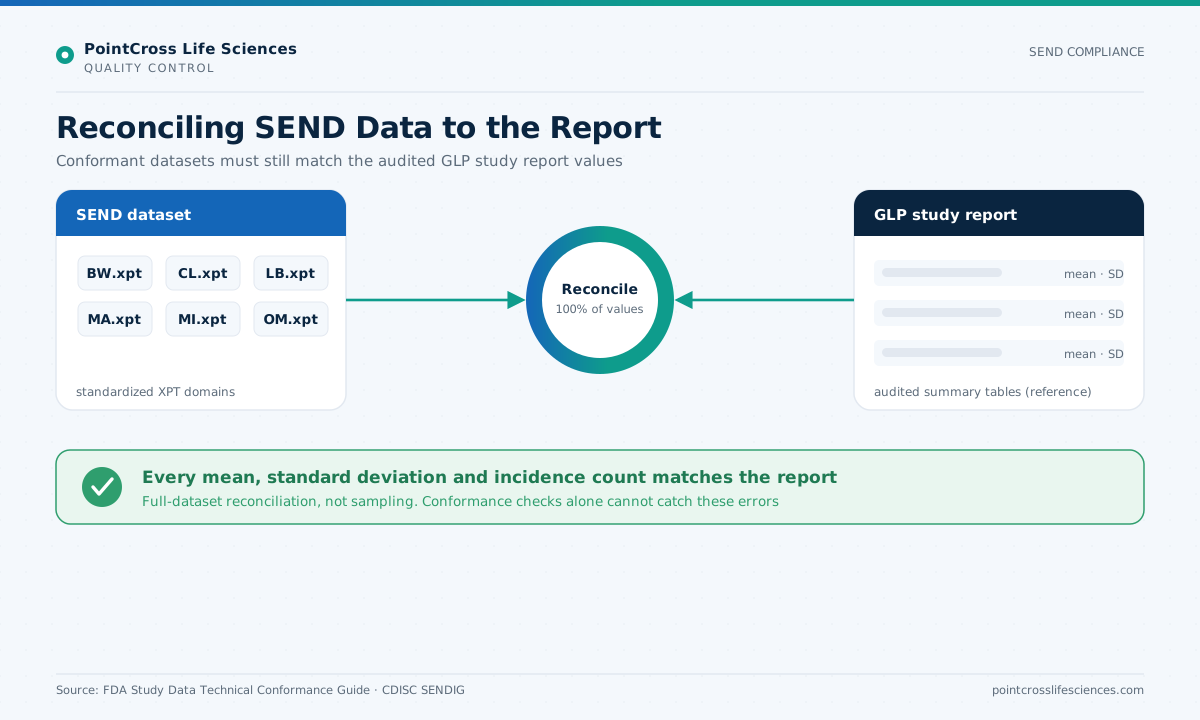
A SEND dataset can be perfectly conformant and still be wrong. Conformance only checks that the data fits the standard’s structure and terminology; it does not check that the numbers match the audited GLP study report. Reconciling the two is one of the most underestimated SEND compliance challenges.
Nonclinical data originates in fragmented systems: LIMS for clinical pathology and in-life observations, separate anatomic pathology systems, bioanalytical platforms for PK, and spreadsheets for everything in between. Each system has its own structure, terminology, and quirks. Mapping all of it into SEND domains while preserving the exact means, standard deviations, and incidence counts reported in the study report demands rigorous cross-checking. When a SEND dataset cannot regenerate the summary tables in the final report, FDA reviewers notice, and information requests follow.
This is where many CROs rely on manual spot-checks, which scale poorly and miss systematic errors. A stronger approach regenerates 100% of the study report’s summary tabulations from the SEND dataset and reconciles every value, including categorical incidence counts in domains like CL, MA, and MI. PointCross’s SEND-ASSURE quality-check service does exactly this, treating the audited study report as the trusted reference and checking the full dataset rather than sampling it. Getting source data into a clean, analysis-ready state before conversion also matters, which is why dedicated data quality assurance belongs upstream of SEND generation.
Challenge 4: The nSDRG Authoring Burden and Specialized Study Types
The nonclinical Study Data Reviewer’s Guide is often the hardest document in the package to produce well, and specialized study types make it harder. The nSDRG is a plain-language PDF that orients FDA reviewers to the datasets, explains the study design, and justifies any deviation from pure SEND, such as custom domains or intentionally empty domains.
The challenge is that the nSDRG must be internally consistent with the datasets and the Define-XML, and it must reflect the correct controlled terminology versions. An nSDRG that is incomplete or contradicts the data is a common trigger for FDA information requests. The PhUSE nonclinical working group maintains a template, but a template does not write the rationale; experienced scientific judgment does.
Specialized and emerging study types compound the burden:
- Carcinogenicity studies require a
tumor.xptcompanion file that sits outside the core SEND standard and must be traced to SEND domains in the nSDRG. - DART and juvenile studies introduce post-natal-day timing concepts that SENDIG v3.1.1 represents awkwardly, an area the agency has clarified repeatedly.
- Immunotoxicity, neurobehavioral, and ophthalmology endpoints are not fully modeled until SEND 4.0 arrives, forcing custom domains today.
Each of these requires the nSDRG to carry more explanatory weight, and each is a place where inexperienced preparers stumble. Outsourcing the documentation and standardization decisions to specialists removes a major source of risk (see nonclinical data concierge support).
Challenge 5: Tight Timelines, Study Volume, and Resourcing
The business reality behind every SEND deliverable is that CROs face compressed timelines and growing study volume with finite specialist headcount. SEND expertise is scarce, the standards demand continuous training, and sponsors increasingly expect interim datasets during the study rather than only at the end.
The traditional model treats SEND as a sequential, post-report step: finalize the study report, then convert to SEND weeks later. That sequencing creates a bottleneck and a consistency risk, because the dataset and the narrative are built separately and must be reconciled after the fact. When study volume spikes, the SEND backlog grows and submission dates slip.
A better operating model derives both the study report and the SEND dataset from a single versioned data model, so the submission package is essentially complete when the Study Director signs off rather than weeks later. PointCross frames this as Single Track processing, which compresses report-plus-SEND delivery and removes the post-hoc reconciliation step. Pairing that with interim monitoring lets sponsors see standardized data as the study runs rather than waiting for lock (see interim nonclinical study monitoring). The result is faster turnaround without adding headcount, which is the only sustainable way to absorb rising volume.
How Nonclinical CROs Can Get Ahead of SEND Compliance
The CROs that handle SEND well share a pattern: they design for SEND from study start, validate continuously against the correct FDA engine, reconcile datasets to the report in full rather than by sampling, and centralize standards and terminology management so version changes are absorbed once rather than per study. The tooling exists to make this routine rather than heroic.
PointCross brings these pieces together across preparation, QC, validation, and submission packaging, and supports the analytics layer for cross-study nonclinical insight as well, so standardized data becomes an asset rather than a one-time submission cost.
Frequently Asked Questions
What is SEND compliance and why is it required?
SEND compliance means submitting nonclinical study data in CDISC’s Standard for Exchange of Nonclinical Data format, with a Define-XML metadata file and an nSDRG. The FDA requires it under Section 745A(a) of the FD&C Act for in-scope studies in IND, NDA, ANDA, and certain BLA submissions, so reviewers receive consistent, machine-readable data.
Which nonclinical studies require SEND datasets?
Single-dose and repeat-dose general toxicology, carcinogenicity, cardiovascular and respiratory safety pharmacology, embryo-fetal development (under SENDIG-DART v1.1), and in vivo genetic toxicology micronucleus and comet assays (under SENDIG-Genetox v1.0) require SEND when the study start date falls after the relevant FDA requirement date. SEND applies to both GLP and non-GLP studies when the design is in scope.
What is the most common reason the FDA technically rejects a submission?
Validation rule 1734, a missing or invalid Trial Summary dataset (ts.xpt), is the most common technical rejection reason, and it disproportionately affects nonclinical studies. FDA data show 453 nonclinical studies failed Rule 1734 between September 15, 2021 and February 15, 2023, with 73% caused by a missing ts.xpt file. Automated gateway rejection began September 15, 2021.
What is the nSDRG and why is it hard to author?
The nonclinical Study Data Reviewer’s Guide is a PDF that explains the SEND datasets to FDA reviewers, describing study design and justifying any deviation from the standard. It is hard because it must stay perfectly consistent with the datasets, the Define-XML, and the controlled terminology versions used, and inconsistencies trigger FDA information requests.
Is Define-XML 2.1 required for SEND submissions?
Yes. Define-XML v2.1 is required for SEND packages for studies starting after March 15, 2023. It is a machine-readable metadata file describing every dataset, variable, and controlled terminology version in the package, and Define-XML v2.0 is no longer accepted for new in-scope submissions.
What is changing in SEND 4.0?
SEND 4.0 is expected to add about eight new domains, including in vivo genetic toxicology, cell phenotyping, immunogenicity, ophthalmology, nervous system tests, and skin tests, while deprecating the Tumor Findings and Bodyweight Gains domains. Per Certara, the current CDISC target for publication is June 2026, and it is not yet an FDA requirement.
Don’t let an avoidable error delay your submission
PointCross supports SEND submissions with dataset preparation, 100% report-reconciled QC, and FDA-rule-aware validation. Get expert eyes on your datasets before they reach the gateway.
External References
- FDA Study Data for Submission to CDER and CBER — https://www.fda.gov/industry/study-data-standards-resources/study-data-submission-cder-and-cber
- CDISC SENDIG v3.1.1 standard page — https://www.cdisc.org/standards/foundational/send/sendig-v3-1-1
- PHUSE Nonclinical Study Data Reviewer’s Guide working group — https://advance.hub.phuse.global/wiki/x/nQCZAQ