

Table of Contents
The Assumption That Costs Drug Programs Weeks
There is a moment in almost every nonclinical submission cycle where the team exhales. The SEND package is back from the vendor, the validator report shows green, and the file goes into the eCTD. Job done.
Except sometimes it is not.
Sponsors do not always find out until FDA reviewers flag the submission as unusable, not because anything failed the conformance check, but because the SEND dataset and the study report are telling two different stories. Group means do not reconcile. Incidence counts cannot be reproduced. Set definitions do not reflect what the study report describes.
None of that shows up in a validator. The validator was never designed to catch it.
This is one of the most underappreciated quality risks in nonclinical regulatory submissions, and it is one that the FDA’s March 2026 Study Data Technical Conformance Guide (TCG) addresses directly, dedicating an entire appendix to SEND verification best practices before submission. If your current SEND process does not include structured reconciliation against the final study report, your submission quality is resting on an assumption you have not verified.
This guide breaks down exactly what can go wrong, what the FDA expects, and how the most experienced SEND teams in the industry have built processes that make that failure mode structurally impossible.
What Is SEND and Why FDA Compliance Depends on More Than Conformance
SEND (Standard for Exchange of Nonclinical Data) is the CDISC-defined implementation standard for submitting electronic nonclinical study data to the FDA. It covers toxicology, safety pharmacology, and reproductive and developmental studies submitted as part of commercial IND, NDA, and BLA filings.
SEND has been required for commercial INDs since December 17, 2017, and for NDA/BLA submissions for studies initiated after December 17, 2016. It is now a foundational part of how FDA reviewers at CDER and CBER assess nonclinical safety.
When a SEND package is complete, consistent with the study report, and conformant with the applicable SENDIG version, reviewers can efficiently query the data and assess study outcomes. That is the scenario everyone is working toward.
When it is not complete or consistent, the consequences are not minor. The TCG is clear that SEND submitted with certain errors is classified as unusable. Not flagged for correction. Not sent back with a request for information. Unusable.
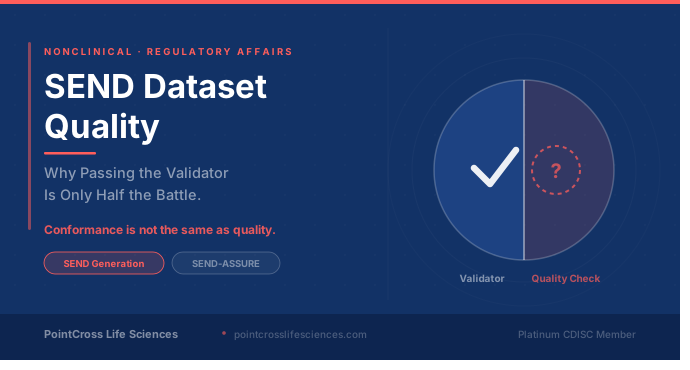
The distinction between conformance and quality is where most teams underestimate their risk.
Conformance means the dataset follows the structural rules of SENDIG: correct variable names, correct data types, required fields populated, valid controlled terminology applied. Automated validators, including the FDA’s own eCTD validation criteria, test for conformance.
Quality means the dataset accurately and completely represents the study that was actually conducted, as described in the final study report. No automated tool tests for this. It requires human-driven, structured reconciliation.
A SEND package can be 100% conformant and still be scientifically wrong. That is the gap.
The Three SEND Failure Categories the FDA Has Officially Named
Appendix I of the March 2026 TCG organizes the most common SEND usability failures into three categories. Understanding all three is the starting point for building a process that prevents them.
Category 1: Submission-Level Issues
These are structural problems with how the SEND package is assembled and organized within the eCTD:
- Files placed in incorrect folder locations within the Module 4 structure
- File names that include anything beyond the domain abbreviation and .xpt extension
- Missing files that are referenced in define.xml but not present in the submission folder
- Files from more than one study included in the same study submission folder
- Dataset files that are 0 KB in size
These errors are avoidable and often caught before submission, but they are more common than teams expect when packages are assembled under deadline pressure from multiple sources.
Category 2: SENDIG Conformance Violations
This is what validators are built to catch:
- Violation of record uniqueness constraints (for example, two findings records sharing the same USUBJID and sequence value)
- Empty required variables such as DSDECOD
- Variable values that exceed maximum allowable character lengths (LBTESTCD values over 8 characters is a common example)
- Data types that are inconsistent with SENDIG specifications
- Invalid cross-file references, such as POOLID values in a findings domain that do not exist in POOLDEF
These are real errors that create real problems, and your conformance validator should catch most of them before submission.
Category 3: Data Representation Failures
This is the one validators cannot touch. Category 3 covers discrepancies between what the SEND dataset contains and what the study report actually says:
- Group summary means in SEND that do not match the summary tables in the study report
- Incorrect set definitions, such as terminal and recovery animals placed in the same set
- Qualitative incidence counts that cannot be reproduced from the SEND data
- Multiple records for the same animal, endpoint, day, and timepoint with conflicting values
- Terminal and recovery animals assigned the same DSDECOD
Category 3 failures do not come with validator error codes. They sit quietly in the dataset until an FDA reviewer attempts to use the data, and then they render the entire submission unusable.
This is the category that delays programs. It is also the most preventable, but only if your process includes systematic reconciliation.
The Real Root Cause: Why SEND Discrepancies Are Structurally Predictable
Category 3 failures are not random. They are a predictable consequence of how SEND has traditionally been produced.
In the conventional workflow, the Study Report and the SEND dataset are generated by two completely separate teams, running two completely separate processes, from the same underlying study data, but without a shared data model connecting them. The Study Report team finalizes the report, and then the SEND team begins. They extract, re-integrate, and rebuild what was already built once.
This creates three compounding problems.
- Timeline inflation. Because SEND generation begins only after the Study Report is complete, the total submission package timeline stacks sequentially: roughly 4 to 5 weeks for the Study Report, followed by another 4 to 6 weeks for SEND generation and QA. That is 8 to 10 weeks total for a package that could theoretically be completed in half that time if both processes ran concurrently from shared data.
- Duplicated integration effort. Protocol metadata, LIMS data, non-LIMS sources (bioanalysis, ADA, FACS, omics, ECG, immunology markers), and Study Report methods sections all have to be extracted and interpreted independently by both teams. Every step of that duplication is an opportunity for divergence.
- Reconciliation cost that reflects structural risk. Mechanically comparing the SEND dataset against the study report, which includes digitizing the PDF, extracting summary tables, and harmonizing terminology to CDISC controlled terminology, accounts for approximately 30% or more of total SEND generation cost in conventional workflows. That cost exists precisely because the two processes created inconsistencies that now have to be found and fixed.
When two independent teams work from the same source data without a shared data model, inconsistency is not just a risk. It is a structurally expected outcome.
What the FDA’s 2026 TCG Actually Requires Before You Submit
Appendix I of the March 2026 FDA Study Data Technical Conformance Guide outlines minimum verification practices for SEND data prior to submission. These are not aspirational guidelines. They define what the FDA considers baseline due diligence.
A submission-ready SEND package must satisfy all of the following:
- Full traceability. Every value in the SEND dataset must trace back to the study raw data and to the study report. Not some values. Every value.
- Accurate study design representation. The trial design datasets (TE, TA, TX, DM) must correctly represent the study design as described in the study report, with particular attention to trial set organization and its relationship to dose groups.
- Reproducible analyses. It must be possible to conduct group-level analyses from the SEND data that produce results matching the study report summary tables, covering both quantitative endpoints and qualitative incidence counts.
- Documented completeness. Every endpoint in the study report that falls within the scope of the applicable SENDIG version should be included in the SEND package. Any intentional omissions must be documented in the nSDRG with a clear rationale.
- A complete nSDRG. The nonclinical Study Data Reviewer’s Guide must explain the full multi-step process by which SEND was created, including any non-standard approaches, so reviewers can follow the chain from raw data to submitted dataset.
Meeting this standard through informal spot-checks is not sufficient. Meeting it requires structured, documented reconciliation, completed and documented before submission.
Path 1: SEND Dataset Generation with Reconciliation Built In
For sponsors and CROs that engage PointCross to generate SEND from the start, reconciliation is not a final step that happens after generation. It is embedded in the process itself, which means the structural conditions for divergence are eliminated before a single domain file is produced.
PointCross uses a Universal Data Model (UDM), a single canonical data source that feeds both the Study Report and the SEND dataset concurrently. When both outputs draw from the same integrated source, the question of whether they match each other is answered by design, not by downstream comparison.
What every PointCross SEND Generation engagement includes:
- Trial Summary and Trial Design domains generated directly from protocol metadata and Study Report methods sections, using PointCross’s TS Generator Tool and TD Automation Tool. This covers TS.xpt and all Trial Design files (TE, TA, TX, DM, EX).
- Individual subject data compiled from LIMS extracts and all non-LIMS sources, including bioanalysis, ADA assays, FACS panels, immunology markers, multi-omics data, and ECG findings, integrated once into the UDM and never re-extracted.
- Full SEND XPT package generated through the Xbiom platform’s SEND Generator, mapped precisely to the applicable SENDIG version and controlled terminology, covering all Findings, Trial Design, and special domains.
- Define.xml generated via Xbiom’s Define.XML tool and delivered in both XML and annotated PDF format.
- nSDRG generated from a templated base with annotations drawn from study report extracts and the Reconciler, partially filled and ready for final review.
- Validation reports run against FDA TCG requirements and Technical Rejection Criteria using PointCross’s own validators, with results reviewed before delivery.
- Consolidated Quantitative and Qualitative Reconciliation Report, a systematic comparison of group summary means and qualitative incidence counts between the SEND dataset and the study report, covering every endpoint, every domain, every finding. This is a standard deliverable, not an optional add-on.
When PointCross generates your SEND, every value is traceable and every summary is verified before the package leaves our hands.
Ready to generate SEND with built-in reconciliation?
Request a Quote for SEND Dataset Generation
Path 2: SEND-ASSURE for CRO and Third-Party Generated Datasets
If your CRO has already delivered a SEND package and you need to verify its quality before filing, SEND-ASSURE provides an independent, structured audit that applies the same reconciliation standard to externally generated datasets.
SEND-ASSURE is not a second pass through a conformance validator. It is a full quality audit built around the study report as the ground truth.
The process starts from the final PDF study report alone. PointCross independently regenerates machine-readable reference files, including the Trial Summary (TS.xpt), Trial Design domains, and Study Report Summary (SRS) tables covering all quantitative summary tables and qualitative incidence count tables, without reference to the submitted SEND package. Those independently generated files become the comparison baseline.
The submitted SEND dataset is then compared against that baseline, domain by domain, endpoint by endpoint. Because the comparison baseline is built independently rather than derived from the dataset under review, discrepancies have nowhere to hide.
SEND-ASSURE deliverables include:
- A data discrepancy summary covering every instance where the submitted SEND dataset diverges from the study report, organized by domain and finding type.
- A conformance and terminology report identifying discrepancies against the applicable SENDIG version and selected controlled terminology, with validator error codes and warning classifications.
- A reconciliation report comparing summary and incidence counts regenerated from SEND against the SRS file, covering both quantitative endpoint summaries and qualitative incidence tables, with full documentation of any gaps.
- Remediation guidance or direct corrections, depending on scope, so your team has a clear path to resolving every identified issue before submission.
Every domain. Every table. Every finding. Before the package reaches FDA reviewers.
Already received SEND from your CRO?
Request a SEND-ASSURE Quality Check
Comparing Your Options Side by Side
| SEND Generation by PointCross | SEND-ASSURE | |
|---|---|---|
| Best for | Sponsors and CROs engaging PointCross from the start | Sponsors auditing CRO or third-party SEND before filing |
| Starting point | Raw data, LIMS extracts, study protocol, study report | Finalized CRO-generated SEND package |
| Reconciliation | Built into generation via unified data model | Independent audit from study report as baseline |
| Standard deliverables | SEND XPT package, Define.xml, nSDRG, validation reports, reconciliation report | Discrepancy report, conformance report, reconciliation report, remediation guidance |
| FDA outcome | Complete, traceable, reviewer-ready submission package | Verified quality and conformance before submission |
Both paths deliver the same outcome: a SEND package the FDA can actually use.
FAQs: SEND Quality, Validators, and FDA Submissions
What is SEND in the context of FDA drug submissions?
SEND stands for Standard for Exchange of Nonclinical Data. It is the CDISC-defined format required by the FDA for electronic submission of nonclinical study data, including toxicology, safety pharmacology, and reproductive and developmental studies, as part of commercial IND, NDA, and BLA filings. The applicable implementation guide is the CDISC SENDIG.
Does passing a SEND validator mean my dataset is ready for FDA submission?
Not necessarily. Validators confirm technical conformance against SENDIG rules: correct variable names, required fields, valid terminology, and structural formatting. They cannot verify whether your SEND dataset accurately represents your study report. Discrepancies in group summary tables, incidence counts, set definitions, and individual subject data are invisible to validators and are the most common cause of SEND being classified as unusable by FDA reviewers.
What makes a SEND dataset unusable by the FDA?
The FDA identifies three failure categories in the March 2026 TCG: submission-level errors (incorrect file locations, naming, missing files), SENDIG conformance violations (caught by validators), and data representation failures (discrepancies between SEND and the study report, which validators cannot detect). The third category is the most consequential and the hardest to catch without structured reconciliation.
What is SEND-ASSURE and who needs it?
SEND-ASSURE is an independent quality audit service from PointCross for SEND packages generated by a CRO or third-party vendor. It compares the submitted SEND dataset against the final study report across every domain, using independently regenerated reference files as the comparison baseline, and delivers a discrepancy report, conformance report, and reconciliation report before submission. Sponsors who receive SEND from an external vendor and want documented verification before filing should use SEND-ASSURE.
What does PointCross include in a SEND generation engagement?
Every PointCross SEND generation engagement delivers the full SEND XPT package (all domains), Define.xml in XML and PDF format, a partially filled and annotated nSDRG, validation reports against FDA TCG and TRC standards, and a Consolidated Quantitative and Qualitative Reconciliation Report. Reconciliation is a standard component of delivery, not an optional service.
How is PointCross different from other SEND vendors?
PointCross is a Platinum member of CDISC and a contributor to PhUSE, and has been serving Biotech and Pharma clients since 2009. A significant percentage of the nonclinical studies submitted to the FDA have been standardized by PointCross. Unlike vendors that treat reconciliation as a final QA step, PointCross builds it into the generation process through a unified data model that eliminates structural divergence between the SEND dataset and the study report before any domain file is produced.
What happens to my data after PointCross generates SEND?
Studies that PointCross generates SEND datasets for, or performs SEND-ASSURE on, are loaded into the Xbiom Nonclinical Insights platform and made available to the customer for 30 days on a secured, private instance. Learn more about the Xbiom platform.
Two Ways to Work with PointCross on SEND
The question before any FDA nonclinical submission is not whether the validator passed. It is whether every value in the SEND package tells the same story as the study report, and whether you have documentation to prove it.
PointCross answers that question before delivery, every time, whether we build the SEND dataset from the ground up or audit what your CRO produced.
Generating SEND from the start? Get the complete SEND package with reconciliation built in, not added on. Request a Quote for SEND Dataset Generation
Already have SEND from your CRO? Get independent, domain-level quality verification before your FDA filing. Request a SEND-ASSURE Audit
Not sure which you need? Contact the PointCross SEND team and we’ll walk you through the right approach for your study and timeline.
About PointCross Life Sciences
PointCross Life Sciences is the leading SEND services provider to top CROs and Biotech and Pharma sponsors. A Platinum member of CDISC and contributor to PhUSE, PointCross has been standardizing nonclinical study data for FDA and PMDA submissions since 2009, with offices in Foster City (CA), Silver Spring (MD), Paris (France), and Bangalore (India). Services include SEND data standardization, SEND-ASSURE quality checks, Data-as-a-Service, and the Xbiom platform for nonclinical research.