

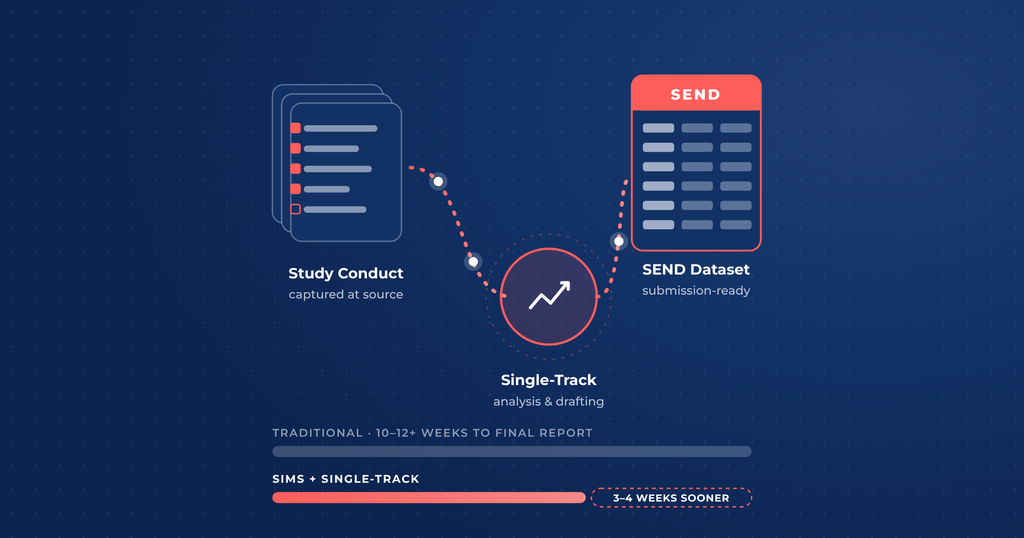
SEND (Standard for Exchange of Nonclinical Data) is the CDISC data format the FDA requires for most nonclinical safety study submissions, mandatory for NDAs since December 2016 and INDs since December 2017. SEND dataset automation means generating that submission-ready dataset directly from the study’s operating record as data is collected, instead of reconstructing it from spreadsheets and instrument exports after the study ends. SIMS and Single-Track do this, which is why SEND datasets and study reports can arrive weeks sooner than the industry norm.
What is SEND, and why does it slow nonclinical reporting down?
SEND is a specialized implementation of the CDISC Study Data Tabulation Model (SDTM) built for animal data from nonclinical toxicology studies. The FDA’s Data Standards Catalog has required SEND datasets for in-scope study types since 2016 for NDA submissions and 2017 for INDs, and coverage has expanded with each new SEND Implementation Guide since. For most sponsors and CROs, SEND is no longer optional paperwork, it’s a hard gate before a submission can be filed.
The slowdown rarely comes from the SEND format itself. It comes from how the underlying data was collected. When a study’s data lives across a LIMS, paper logs, instrument exports, and a pathologist’s spreadsheet, producing a SEND package means reconciling all of it after the fact, then validating the result against FDA business and validator rules before it can go out the door.
The hidden cost of after-the-fact data reconciliation
Industry benchmarks vary, but a commonly cited figure for nonclinical study reporting puts the industry standard at 10 to 12 weeks or longer from study completion to final report. Most of that time is not spent on science, it’s spent reconstructing a complete, defensible record from data that was captured in disconnected places.
How SIMS and Single-Track automate SEND generation
SIMS captures study conduct directly against the Digital Protocol along linked with facility SOPs maintain quality standard: every activity is logged through eForms at the point of work, time-stamped and attributed at the source, mapped to the Schedule of Activities that governs it. Single-Track then analyzes that same record, rather than a reconstruction of it, to generate the study report and the SEND dataset together. The SEND package is a byproduct of how the study was conducted, not a separate project that starts after the study ends. “Eliminate redundant work by using a single data collection stream for both study reports and SEND deliverables.”
SEND automation versus standalone SEND tools
Most SEND-focused software on the market today is built to analyze or convert data after it has already been collected: visualization tools for reviewing finished or interim datasets, or conversion utilities that map existing exports into SEND format. Those tools are valuable for what they do. The distinction with SIMS and Single-Track is when the SEND-relevant structure gets established: at the point of data capture during the study, not during a conversion step afterward. That’s what removes the reconciliation step rather than just speeding it up.
What this means for IND timelines
For a sponsor racing toward an IND filing, every week removed from the nonclinical reporting cycle is a week back in the overall program timeline. A report and SEND package generated directly from the operating record, rather than assembled from five sources after the study ends, is the mechanism behind the 3 to 4 week reduction PointCross cites for SIMS and Single-Track.
FAQ
What is SEND (Standard for Exchange of Nonclinical Data)?
SEND is the CDISC-developed, FDA-required data standard for submitting nonclinical (animal toxicology) study data in a structured, machine-readable format, used for IND, NDA, and related submissions.
Is SEND mandatory for FDA submissions?
Yes, for in-scope nonclinical study types. The FDA’s Data Standards Catalog has required SEND datasets for NDA submissions since December 17, 2016, and for IND submissions since December 17, 2017, with scope expanding under newer SEND Implementation Guides.
How long does it typically take to prepare a SEND dataset?
Industry estimates commonly cite 10 to 12 weeks or longer for full nonclinical study reporting when data is reconciled after study completion. SIMS and Single-Track are designed to generate the report and SEND dataset together from the study’s operating record, cutting that cycle by an estimated 3 to 4 weeks.
Can SIMS work alongside our existing LIMS and SEND tools?
Fill in with specifics on integration and coexistence; not in the source material available when drafting.
Related reading: Why Preclinical CROs Need More Than a LIMS