

Why Preclinical CROs Need More Than a LIMS
Quick answer: A Laboratory Information Management System (LIMS) captures and stores study data. It was never built to manage the operational side of a preclinical CRO: capacity planning, resource scheduling, continuous compliance, and report generation. SIMS, the Study Information Management System built on PointCross’s Xbiom platform, is the connected operating layer that sits underneath study conduct and reporting to close that gap.
What a LIMS does, and what it was never built to do
A Laboratory Information Management System is designed to capture, store, and track sample and study data inside the lab. Most LIMS platforms in use at preclinical CROs today are built on architecture that dates from the 1980s and 1990s, extended over decades rather than re-architected. They do that core job well. What they were not scoped to do is answer the questions that determine whether a CRO can actually run its business: can we commit to this study, do we have the right resources at the right time, and can we produce a report without a separate reconstruction effort at the end.
The operating gap: 5 questions every CRO must answer
Most CROs still answer these by spreadsheet, reconciled by hand at every handoff:
- Can we commit to this study?
- Do we have the right resources at the right time?
- Are we compliant continuously, not just before an inspection?
- Where does each study actually stand right now?
- Will we deliver on time?
These are not technology questions. They are operational ones, and today the answer to each is usually only as current as the last person who updated a spreadsheet.
What is a Study Information Management System (SIMS)?
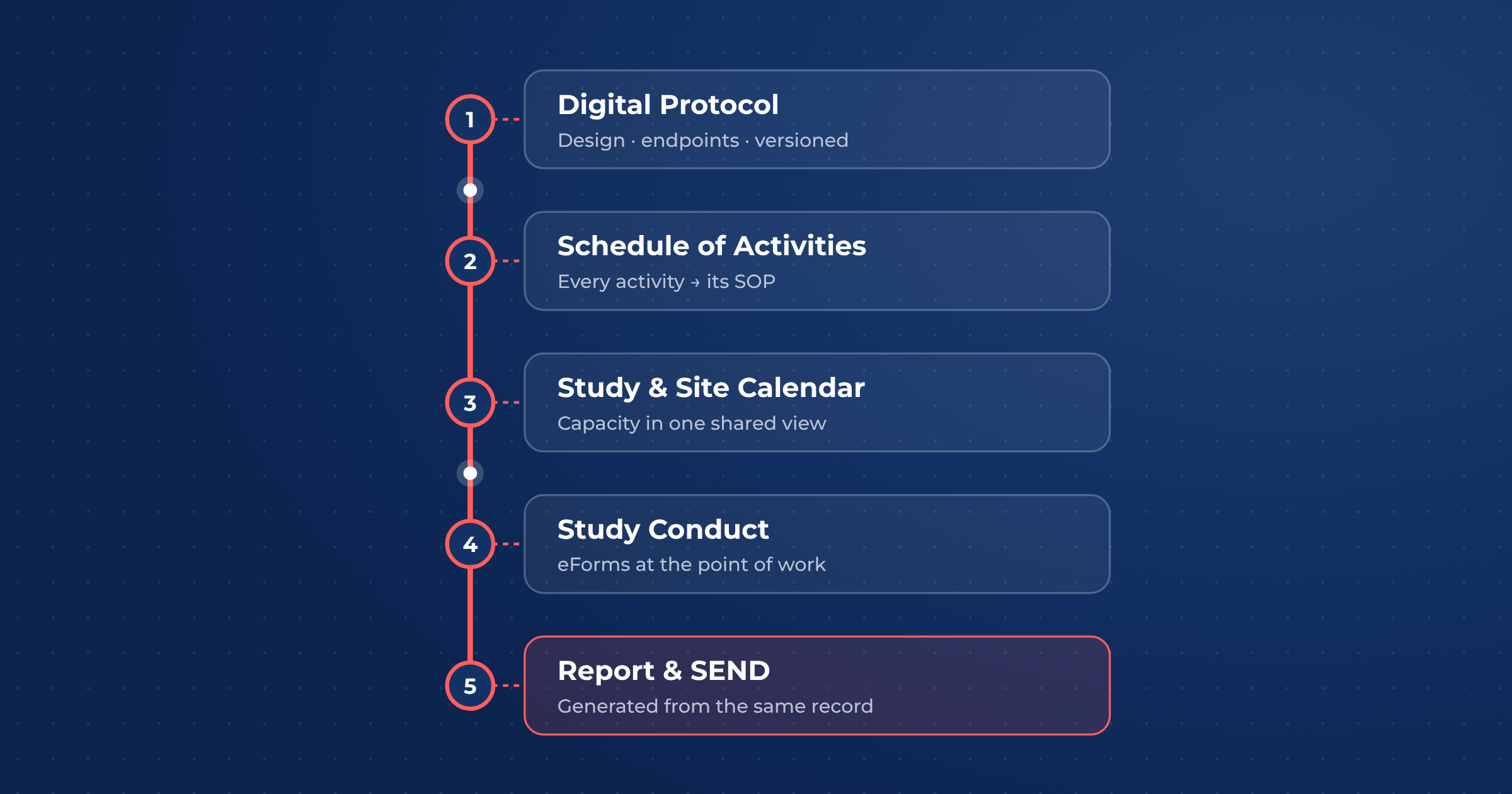
A Study Information Management System treats the protocol as the source of every activity and every data point, then carries it through the study as one connected record rather than a series of handoffs between separate tools. SIMS, built on PointCross’s Xbiom platform, is structured around five connected layers:
- Digital Protocol: study metadata, design, formulation, and endpoints under version control
- Schedule of Activities: every activity mapped to its governing SOP
- Study and Site Calendar: capacity read from one shared view instead of assembled from spreadsheets
- Study Conduct: eForms completed at the point of work, time-stamped at the source
- Report and SEND: handed to Single-Track for scientific review and CDISC SEND generation, from the same record that guided conduct
“SIMS bridging the gap from sponsor talk to SEND delivery by CRO”
What changes for a CRO
| Traditional model | With SIMS |
| Capacity is estimated | Capacity is visible |
| Studies scheduled manually | Resources coordinated from a shared calendar |
| Data entered on paper, re-entered later | Captured once, at the source |
| Reports assembled from multiple sources | Generated from the operating record |
| Audit-readiness achieved through preparation | Audit-readiness accrues as work happens |
The downstream effect: study reports and SEND datasets arriving weeks sooner, because Single-Track analyzes and drafts from a record that is already complete, not one that has to be assembled first. Post 2 below covers this in detail.
Built for GLP compliance from the start
SIMS is designed for 21 CFR Part 58 and OECD GLP compliance, with 21 CFR Part 11 audit trails and electronic signatures, SOC 2–certified infrastructure, and IQ/OQ/PQ validation documentation for each CRO’s own computerized system validation. Post 3 below goes deeper on what continuous compliance looks like in practice.
FAQ
What is the difference between a LIMS and a SIMS?
A LIMS manages sample and study data inside the lab. A Study Information Management System (SIMS) manages the operational layer around the study, capacity, scheduling, compliance, and reporting, that a LIMS was never built to handle.
Does SIMS replace our existing LIMS?
No. SIMS is designed to sit alongside existing lab systems as the operating layer that coordinates capacity, schedule, and reporting across them, not to replace instrument- or sample-level data capture.
Is SIMS GLP and 21 CFR Part 11 compliant?
Yes. SIMS is built for 21 CFR Part 58 and OECD GLP compliance with 21 CFR Part 11 audit trails and electronic signatures, and ships with IQ/OQ/PQ validation documentation to support each CRO’s computerized system validation.
What is Single-Track?
Single-Track is PointCross’s scientific review and reporting engine built on Xbiom platform. It analyzes the study record SIMS produces and generates the report and SEND dataset directly from it.