

Table of Contents
Most nonclinical CROs deliver the study report and SEND dataset 8 to 10 weeks after data completion, because two teams rebuild the same study findings twice. You can compress that to 2 to 3 weeks after data lock by producing both deliverables from one governed data source instead of two parallel workflows. This article explains how the single-source model works, what the FDA still requires, and how a COO or Study Director should evaluate the switch.
The math driving this is simple. A nonclinical safety study produces two outputs from the same underlying data: a GLP study report and its companion SEND dataset. When those outputs are built separately and in sequence, you pay for the same data integration twice and inherit reconciliation risk between the two.
Why the Study Report and SEND Dataset Usually Take 8-10 Weeks
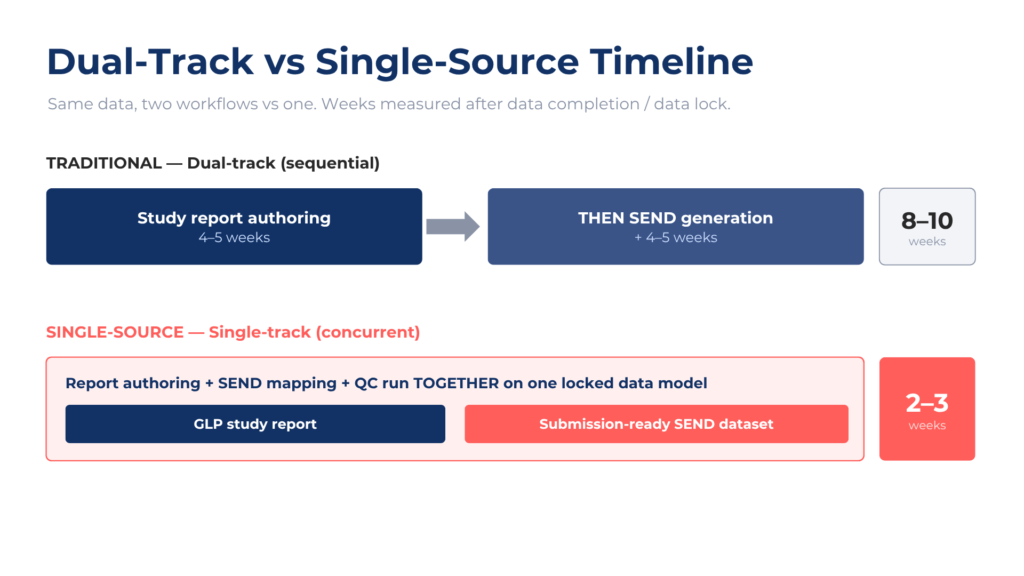
The study report and SEND dataset take 8 to 10 weeks because they are produced on two separate, sequential tracks from the same data. The report is finalized first, then SEND preparation starts, adding 4 to 5 weeks on top of the reporting cycle.
Here is the sequence at a traditional CRO. After data completion, the reporting team spends roughly 4 to 5 weeks aggregating tables, figures, listings, and interpretive narrative into the study report. Only then does the SEND team begin, re-extracting the same LIMS, pathology, and bioanalytical data to map it into SEND domains. That second pass adds another 4 to 5 weeks.
This dual-track model persists out of convention, not because it serves anyone well. It creates three problems that compound across a portfolio.
- Duplicated effort. Protocol metadata extraction, data integration, and tabulation happen twice. Where report appendices include domains not captured in LIMS, PointCross estimates reconciliation cost can approach 40% of the effort.
- Reconciliation risk. Because the report and the dataset come from two independent processes, values drift apart. A body weight that differs by a single rounding digit between the report and the dataset is enough to trigger an FDA information request.
- Timeline drag. For a sponsor racing an IND-enabling program, the extra month of sequential SEND work is a month of lost option value.
When SEND was first mandated in 2016, a large share of early datasets did not match the audited reports. That legacy is why report-to-dataset consistency is now the step reviewers scrutinize most.
Cut two workflows down to one
Single-track processing generates the GLP study report and a submission-ready SEND dataset at the same time, from one governed data model, so you stop paying for the same integration twice.
See How Single-Track Works →
https://pointcrosslifesciences.com/single-track-processing/
What “One Source” Actually Means
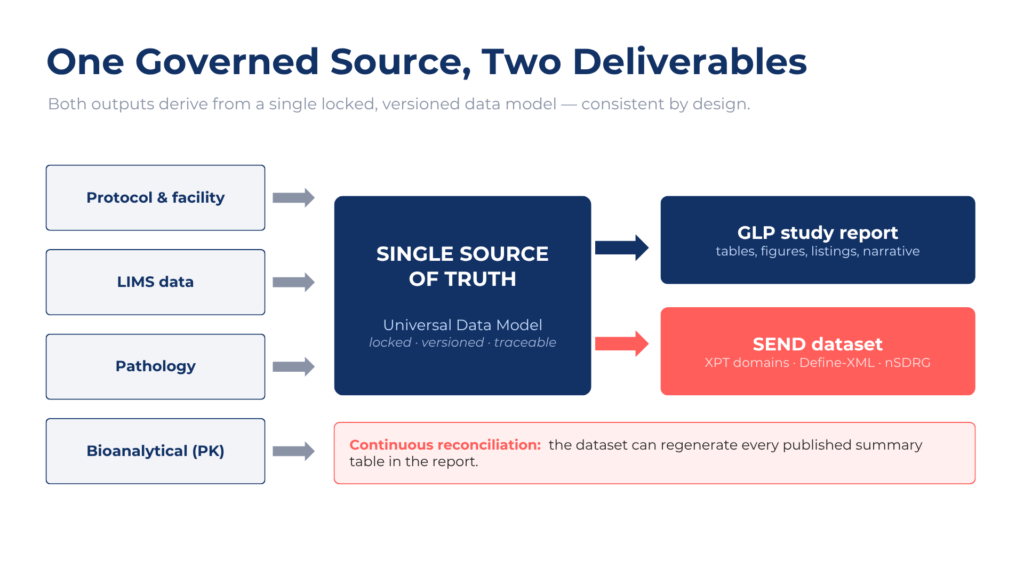
“One source” means a single, locked, versioned study data model that feeds both the study report and the SEND dataset, so the two deliverables are derived from identical data rather than reconciled after the fact. This is the single source of truth concept applied to nonclinical reporting.
The unified data model
Protocol, facility, and LIMS data are ingested into one continuous governed data flow. From that flow, the platform drafts report sections and summary tables, and it maps the same as-collected data into SEND domains. Because both outputs trace back to one model, structural consistency between the report and the dataset is built in, not chased.
PointCross builds this on its Xbiom nonclinical analytics and warehousing platform, converting source data into a Universal Data Model that outputs the selected SENDIG version and CDISC Controlled Terminology, with full bi-directional traceability from as-collected source data to the final submission. (Learn more about the Digital Study Report workflow that keeps narrative and data aligned from the start.)
What the FDA still requires
Producing faster does not mean producing less. The FDA is the only major regulator that mandates SEND for nonclinical data, and its requirements do not relax for a compressed timeline. A compliant SEND submission package still needs three components:
- SEND datasets as SAS XPT files across the applicable domains, including TS, TX, DM, EX, BW, CL, LB, MI, MA, OM, PC, and PP, plus others by study type.
- Define-XML v2.1, the machine-readable metadata file that describes every dataset and controlled term. Define-XML v2.0 is no longer accepted for new in-scope submissions.
- The nSDRG, the Nonclinical Study Data Reviewer’s Guide, a plain-language PDF built on the PhUSE template that walks reviewers through the dataset and explains any standardization decisions.
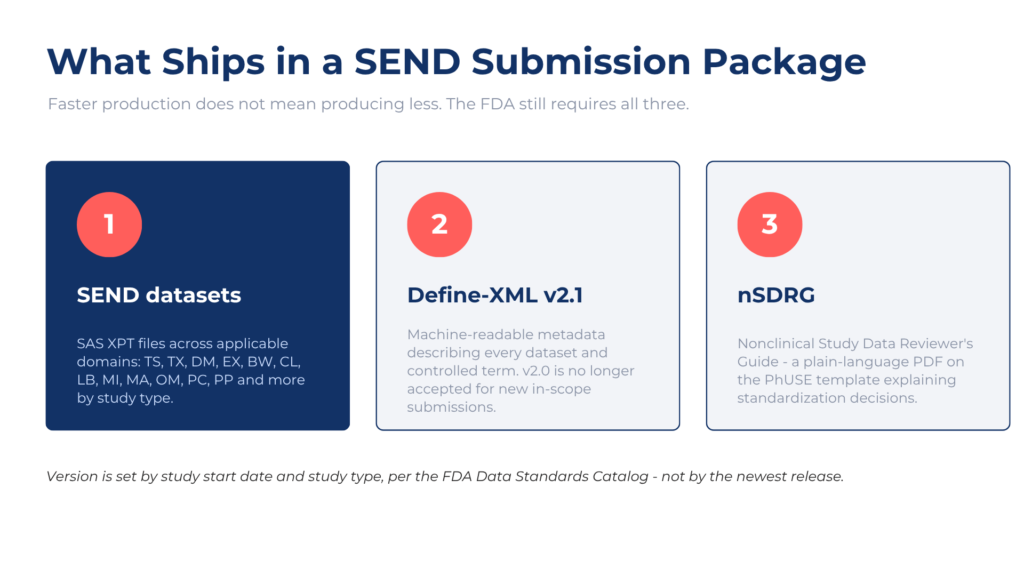
The version you must use is set by your study start date and study type, matched against the FDA Data Standards Catalog [Official FDA permanent guidance URL — stable government resource page], not by the newest release available. SENDIG 3.1.1 is the current baseline for general toxicology and carcinogenicity studies started after March 15, 2023. SENDIG-Genetox v1.0 became mandatory for in vivo micronucleus and comet assays; per Federal Register notice 2023-27310 (Docket FDA-2023-N-5022), FDA support began December 13, 2023, and the requirement took effect March 15, 2025 for NDAs, ANDAs, certain BLAs, and INDs to CDER and CBER.
How the 2–3 Week Timeline Works
The 2 to 3 week timeline works because report authoring, SEND metadata capture, and QC run concurrently on one dataset instead of sequentially on two. The dataset is effectively ready at data lock, and the remaining time is review and packaging.
The table below compares the two models.
| Stage | Traditional dual-track | Single-source model |
|---|---|---|
| Report authoring | 4–5 weeks after data completion | Runs concurrently from the shared model |
| SEND generation | Starts after report; adds 4–5 weeks | Generated alongside the report |
| Reconciliation | Manual spot-checking, post-finalization | Built in at source, 100% checked |
| Total time to both deliverables | 8–10 weeks | 2–3 weeks after data lock |
| Cost per study | Baseline | 30–50% lower |
Here is the concurrent workflow in practice:
- Ingest at lock. Protocol, facility, LIMS, pathology, and bioanalytical data flow into one governed model as the study reaches data lock.
- Draft and map together. The system drafts report text and summary tables while simultaneously mapping the same data into SEND domains and populating trial design.
- Reconcile continuously. The dataset is checked so it can regenerate every published summary table in the report. If it cannot, both are corrected until they match.
- Validate and package. Conformance validation against CDISC, FDA, and PMDA rules runs before delivery, and the package ships with Define-XML and the nSDRG. PointCross runs this through its eDataValidator for SEND, SDTM, and ADaM conformance.
That reconciliation step, comparing the dataset against the report record by record, is the difference between a technically valid file and a review-ready one. PointCross reports that 100% of the studies it has quality-checked contained at least one critical conformance or consistency issue, which is why the check cannot be skipped.
Real-time interim monitoring of nonclinical studies before data lock shortens the runway further, because signals are annotated and standardized as the study runs rather than reconstructed at the end.
We can model this against your own study mix and submission calendar rather than a generic example.
Put the timeline math on your own studies
A short working session models the time, cost, and quality impact for your specific portfolio and submission dates.
Request a Free Demo →
https://pointcrosslifesciences.com/request-a-demo/
What a Study Director Keeps Control Of
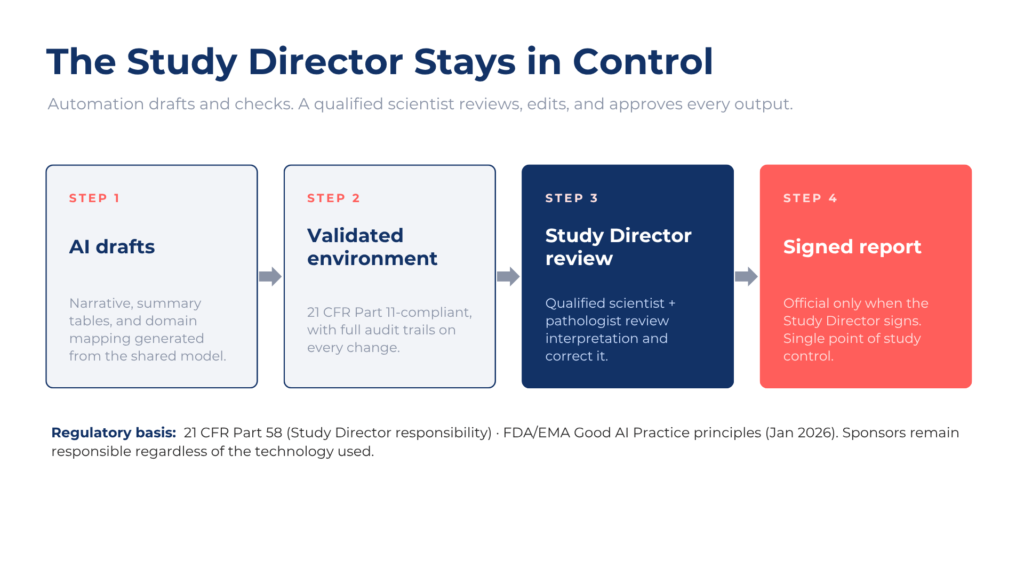
A Study Director keeps full interpretive and sign-off control in the single-source model. Automation handles aggregation, table generation, domain mapping, and cross-checking, while the qualified scientist reviews, edits, and approves every output before finalization.
This distinction separates a defensible workflow from a compliance liability. Under 21 CFR Part 58, the Study Director holds overall responsibility for the interpretation, analysis, documentation, and reporting of results and represents the single point of study control. No tool changes that. The final report is official only when the Study Director signs it.
Regulatory expectations for AI reinforce this. The FDA’s draft guidance “Considerations for the Use of Artificial Intelligence To Support Regulatory Decision-Making for Drug and Biological Products,” issued January 6, 2025 (Federal Register 2025-01-07), sets out a risk-based credibility framework; announcing it, then-Commissioner Robert M. Califf said, “With the appropriate safeguards in place, artificial intelligence has transformative potential to advance clinical research and accelerate medical product development.” The agency also states that sponsors remain responsible for compliance regardless of the technology used. On January 14, 2026, the FDA and EMA published the joint “Guiding Principles of Good AI Practice in Drug Development,” whose first principle reads: “The development and use of AI technologies align with ethical and human-centric values.”
Practically, that means AI-generated narrative and tables are drafts for expert review inside a validated, 21 CFR Part 11-compliant environment with audit trails, not autonomous outputs. A qualified Study Director and toxicologic pathologist review the interpretation, correct it where needed, and approve the final content.
How a COO Should Evaluate the ROI
A COO should evaluate the single-source model on three lines: recovered timeline, lower cost per study, and reduced query risk. Each is measurable against your current process.
Time. Removing the 4 to 5 week sequential gap and delivering both deliverables 2 to 3 weeks after data lock recovers a month or more per program. For a CRO, that is freed capacity and a faster, more attractive turnaround to pitch sponsors.
Cost. Producing the report and dataset from one stream cuts cost per study by 30 to 50%. PointCross frames the baseline as repeat-dose toxicology studies where CROs invest “$10,000+ in Study Report generation and another $10,000+ for SEND production.” With approximately 6,000 nonclinical studies submitted to the FDA annually, PointCross estimates the redundant two-workflow model costs the industry an estimated $150 million a year, with each track consuming roughly $75 million; consolidating the two can improve operating margins by 10-plus percentage points.
Quality and risk. Consistency that reviewers check for is built in when both outputs derive from one locked model. A discrepancy caught by an analyst before submission costs an hour. The same discrepancy caught by an FDA reviewer costs a response cycle, a resubmission, and calendar time you do not control. A noncompliant dataset is technically rejected at the Electronic Submissions Gateway before a reviewer opens it. A missing or malformed ts.xpt is the most common trigger: FDA data presented at the Spring 2023 SEND face-to-face reported that 453 IND, NDA, and BLA nonclinical studies failed Rule 1734 (the ts.xpt study-start-date rule) between September 15, 2021 and February 15, 2023.
For CROs that have already built a dataset and want an independent check, SEND-ASSURE QC provides a review with digitized reconciliation against the study report before submission. If you just need a defensible baseline number, an indicative SEND quote gives you a fixed per-study cost to compare against current spend, and full SEND dataset preparation is available as a turnkey service.
Frequently Asked Questions
How long does it take to produce a SEND dataset and study report?
On a traditional dual-track workflow, both take 8 to 10 weeks after data completion, because the report is finished first and SEND preparation adds another 4 to 5 weeks. Producing both from one governed data source delivers them 2 to 3 weeks after data lock.
Why are the study report and SEND dataset produced separately?
They are produced separately by convention. Most CROs assign the report to one team and SEND to another, working in sequence, so the same LIMS and pathology data is integrated twice. This duplicates effort and introduces reconciliation risk between the two deliverables.
Which nonclinical studies require a SEND dataset?
SEND is required for in-scope studies such as single-dose toxicity, repeat-dose toxicity, carcinogenicity, cardiovascular and respiratory safety pharmacology, embryo-fetal development, and in vivo genetic toxicology, when the study start date falls after the relevant FDA effective date in the Data Standards Catalog. The requirement depends on study type and start date, not on GLP status.
What causes an FDA rejection of a SEND submission?
The FDA’s Electronic Submissions Gateway runs automated technical rejection checks before human review. Common causes include a missing or malformed ts.xpt (Rule 1734), wrong SENDIG version, non-standard controlled terminology, and traceability gaps between the dataset and the study report.
Does AI-generated study report content meet GLP requirements?
It can, when a qualified Study Director reviews, edits, and approves every output inside a validated, 21 CFR Part 11-compliant environment. The Study Director retains overall responsibility as the single point of study control, and the FDA holds sponsors responsible regardless of the technology used.
Deliver both reports two to three weeks after data lock
Stop rebuilding the same study twice. Talk to our nonclinical team about producing GLP study reports and submission-ready SEND datasets from one governed source, with the Study Director in control of every output.
Talk to an Expert →
https://pointcrosslifesciences.com/contact-us/
REFERENCE LIST – EXTERNAL SOURCES USED
- U.S. FDA — Study Data for Submission to CDER and CBER / Data Standards Catalog:
https://www.fda.gov/industry/study-data-standards-resources/study-data-submission-cder-and-cber - U.S. FDA — Study Data Technical Conformance Guide:
https://www.fda.gov/regulatory-information/search-fda-guidance-documents/study-data-technical-conformance-guide-technical-specifications-document - U.S. FDA — Study Data Technical Rejection Criteria (SEND F2F Spring 2023):
https://www.fda.gov/media/169455/download - U.S. FDA — “Considerations for the Use of Artificial Intelligence To Support Regulatory Decision-Making for Drug and Biological Products” (draft guidance, Jan. 6, 2025; Fed. Reg. 2025-01-07):
https://www.federalregister.gov/documents/2025/01/07/2024-31542/considerations-for-the-use-of-artificial-intelligence-to-support-regulatory-decision-making-for-drug - U.S. FDA / EMA — “Guiding Principles of Good AI Practice in Drug Development” (Jan. 14, 2026):
https://www.fda.gov/media/189581/download - 21 CFR § 58.33 (Good Laboratory Practice — Study Director):
https://www.ecfr.gov/current/title-21/chapter-I/subchapter-A/part-58/subpart-B/section-58.33 - CDISC — SEND standard:
https://www.cdisc.org/standards/foundational/send